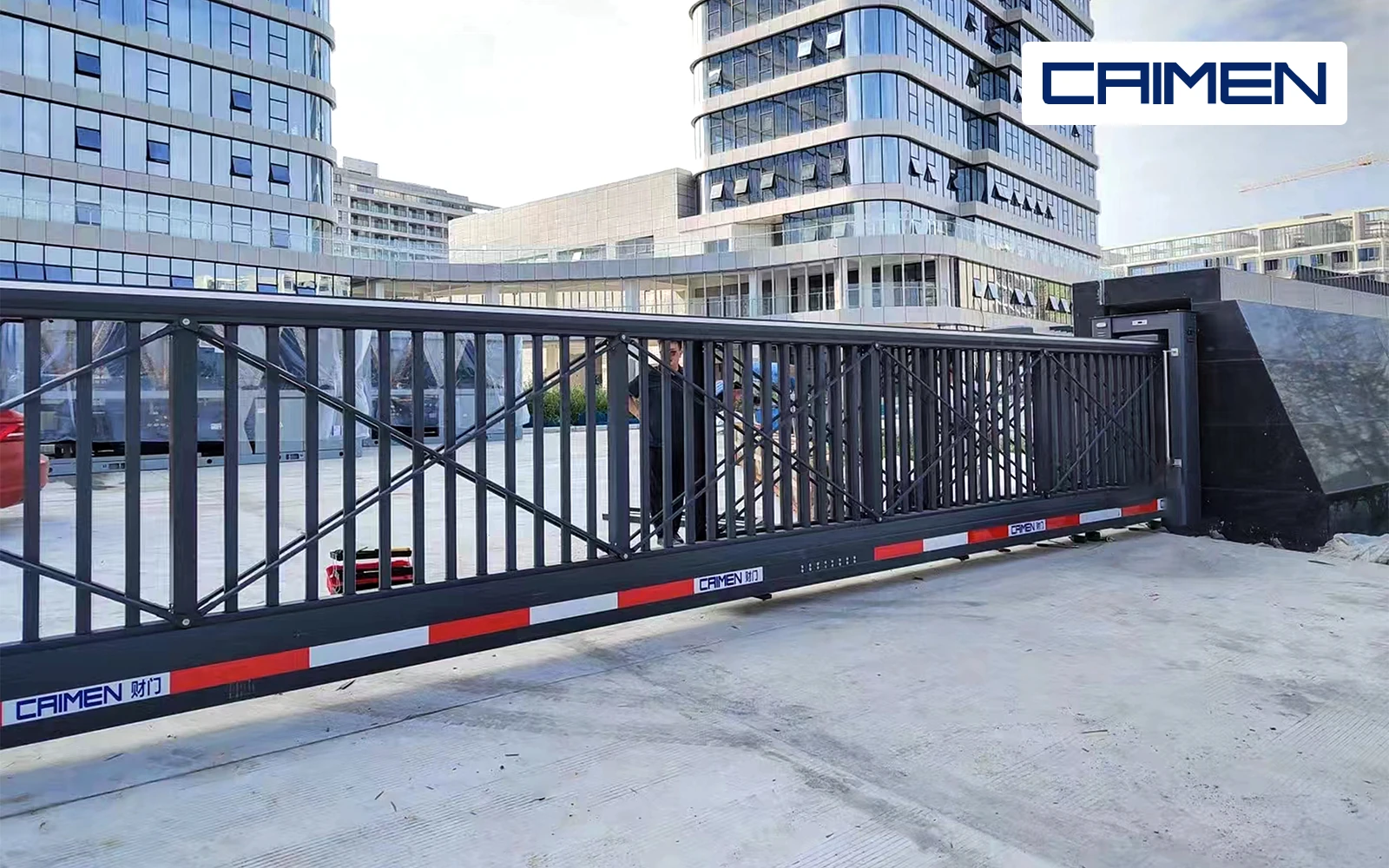
A cantilever gate is a sliding gate supported by rollers or carriages beside the entrance. The moving leaf spans the driveway without wheels running on a continuous ground track across the vehicle passage. A rear extension, commonly called the counterbalance section or tail, forms part of the gate’s support arrangement.
The term cantilever refers to the portion of the gate projecting beyond its supports. The gate still needs supporting hardware and foundations; their position beside the opening keeps the running system out of the roadway.
How does a cantilever gate work?
In a bottom-beam carriage system, the running beam is attached to the moving gate leaf. It passes over fixed roller carriages mounted beside the entrance. When the gate opens, the leaf retracts along the boundary; when it closes, the front portion extends across the opening.
A roller is an individual rotating component. A carriage groups several rollers on a mounting structure. The rollers engage with the beam profile, while guide components help maintain the leaf’s alignment. The beam, carriage arrangement and gate frame need to work together throughout the movement. The frame must have enough rigidity for its design; fitting roller hardware alone does not prevent an inadequately constructed leaf from sagging.
In CAIMEN’s cantilever sliding gates, an aluminum running beam works with fixed roller carriages to support the moving leaf beside the entrance.
Cantilever gates also use other support arrangements, including exposed rollers working against structural rails on the leaf. The shared principle is support from beside the opening. Component positions and installation details vary, so a drawing of one system cannot be treated as an assembly diagram for another.
Why doesn’t it need a ground track?
The gate’s running interface is carried beside the driveway. In an enclosed carriage arrangement, the beam travels over the rollers and supports the leaf across the passage. A track-shaped member may therefore be present on the gate even though no continuous rail is installed in the road surface.
This is the distinction behind trackless: the term describes the absence of a roadway running rail. It does not imply that the gate has no beam, guide or roller system.
A conventional tracked sliding gate carries its moving wheels along a ground rail. Objects on that rail can interfere with wheel travel. A cantilever arrangement avoids this particular running path through the driveway, but its own movement area must remain clear. Snow, vegetation and stored objects can still obstruct the leaf or its retraction area.
What does the counterbalance section do?
The rear section extends behind the part of the leaf that closes the entrance. It participates in the supported arrangement as the gate moves and is included in the overall leaf length. Its geometry is considered together with the support spacing, frame and selected hardware.
Although the name suggests balancing, the tail should not be understood as a separate ballast weight added to an otherwise ordinary sliding gate. Its required length is a design outcome. There is no single tail-to-opening percentage that can be applied to every cantilever system.
The clear opening and the overall gate length are different measurements. The clear opening is the passage available to vehicles. The full leaf includes the rear section as well as the portion closing that passage. Both dimensions matter when checking whether the gate can retract along the boundary.
Cantilever gate vs. tracked sliding gate
Both types move sideways and need a clear travel route. Their main difference is how the moving leaf is supported. That changes the running hardware and the site conditions that need attention.
| Feature | Cantilever sliding gate | Conventional tracked sliding gate |
|---|---|---|
| Leaf support | Rollers or carriages beside the entrance | Moving wheels on a ground rail |
| Running rail across the driveway | No continuous roadway rail | Ground rail forms the running path |
| Space to assess | Full leaf, rear section and retraction area | Leaf travel area and rail route |
| Installation considerations | Support layout, foundations and ground clearance | Rail alignment, supporting surface and wheel clearance |
The mechanism alone does not establish which gate will cost less or require less maintenance. Those comparisons depend on the actual construction, operating equipment and site. Each running system needs the inspection and care specified for its components.
Where does a cantilever gate fit?
A cantilever arrangement is useful where keeping a continuous running rail out of the vehicle passage is desirable and sufficient side space is available. Applications include commercial vehicle entrances, industrial yards and residential driveways. The layout determines suitability within each of these settings.
An entrance can be wide enough for its vehicles but still lack room for a single leaf to retract. Where the boundary is restricted by a wall or corner, telescopic, sectional and folding gate layouts use different movements. Their operating areas need assessment against the same opening and surrounding structures.
Site conditions that need attention
Side space and the complete travel area
Measure the unobstructed distance along the proposed opening direction separately from the clear opening. Include the rear section when reviewing the full leaf. Nearby columns, landscaping and fixed equipment can limit travel even when the boundary appears long enough on a plan.
The required gate height and infill also belong in the design information. An open-bar leaf and a solid-panel leaf should not be assumed to have identical structural requirements. A measured layout and photographs help establish how the gate, supports and adjacent structures fit together.
Foundations and changes in ground level
The absence of a driveway rail does not remove the need for suitable foundations at the support positions. Foundation dimensions depend on the selected arrangement and local ground conditions. They cannot be determined from the opening width alone.
The moving leaf needs clearance above the ground throughout its route. Uneven or sloping ground requires review of that clearance. Crossing a driveway that changes level is different from having the gate itself travel uphill or downhill; the running arrangement must be assessed for the proposed movement.
Automatic operation and safety
A cantilever gate can be automated with equipment matched to the gate configuration. The support mechanism does not determine the operator, control interfaces or safety provision by itself. Vehicle and pedestrian routes affect how the entrance is used and need consideration alongside the movement area.
Moving gates create hazards at closing edges, supports and retraction areas. Removing the roadway rail does not remove those hazards. Qualified installation and a safety assessment are needed for the actual system and location. A diagram of the movement principle is not a construction or safety instruction.
Frequently asked questions
Does a cantilever gate need a ground track?
No continuous running rail is required across the driveway. The leaf is supported beside the entrance. Depending on the hardware, it may have a running beam that engages with rollers or carriages. That moving member is different from a rail fixed in the roadway.
Why does a cantilever gate have a longer rear section?
The rear extension forms part of the supported moving assembly. Its geometry works with the support positions and selected hardware as the gate opens and closes. The required tail length depends on the design, so it should not be assumed from a fixed proportion of the opening.
How much side space does a cantilever gate need?
The side area must accommodate the gate’s retraction, including the rear section and relevant clearances. The clear opening alone is insufficient to determine that space. Review the full leaf length, support layout and nearby obstructions against the selected system’s drawing before confirming that the arrangement fits.
Can a cantilever gate be automated?
Yes. Automatic operating equipment can be specified for a cantilever gate, with the drive and controls matched to its configuration and use. The support mechanism and the automation perform different functions. Safety equipment and control interfaces must be assessed for the complete entrance arrangement.
Is a cantilever gate suitable for a sloped driveway?
It may be suitable if the moving leaf clears the ground throughout its travel and the support arrangement fits the site. Clearance over a sloping surface is different from making the gate travel on an incline. The proposed levels and movement require review before suitability is confirmed.