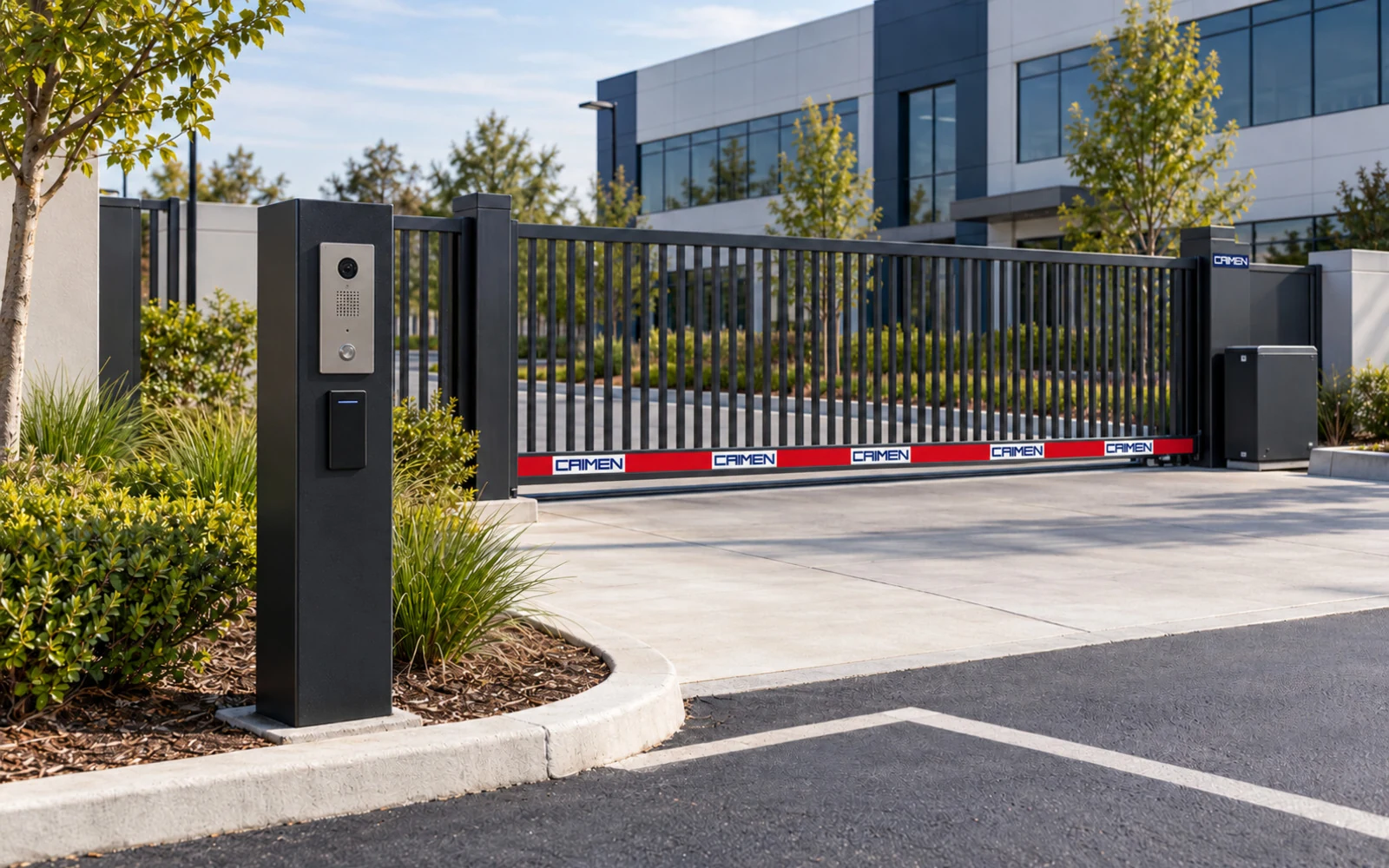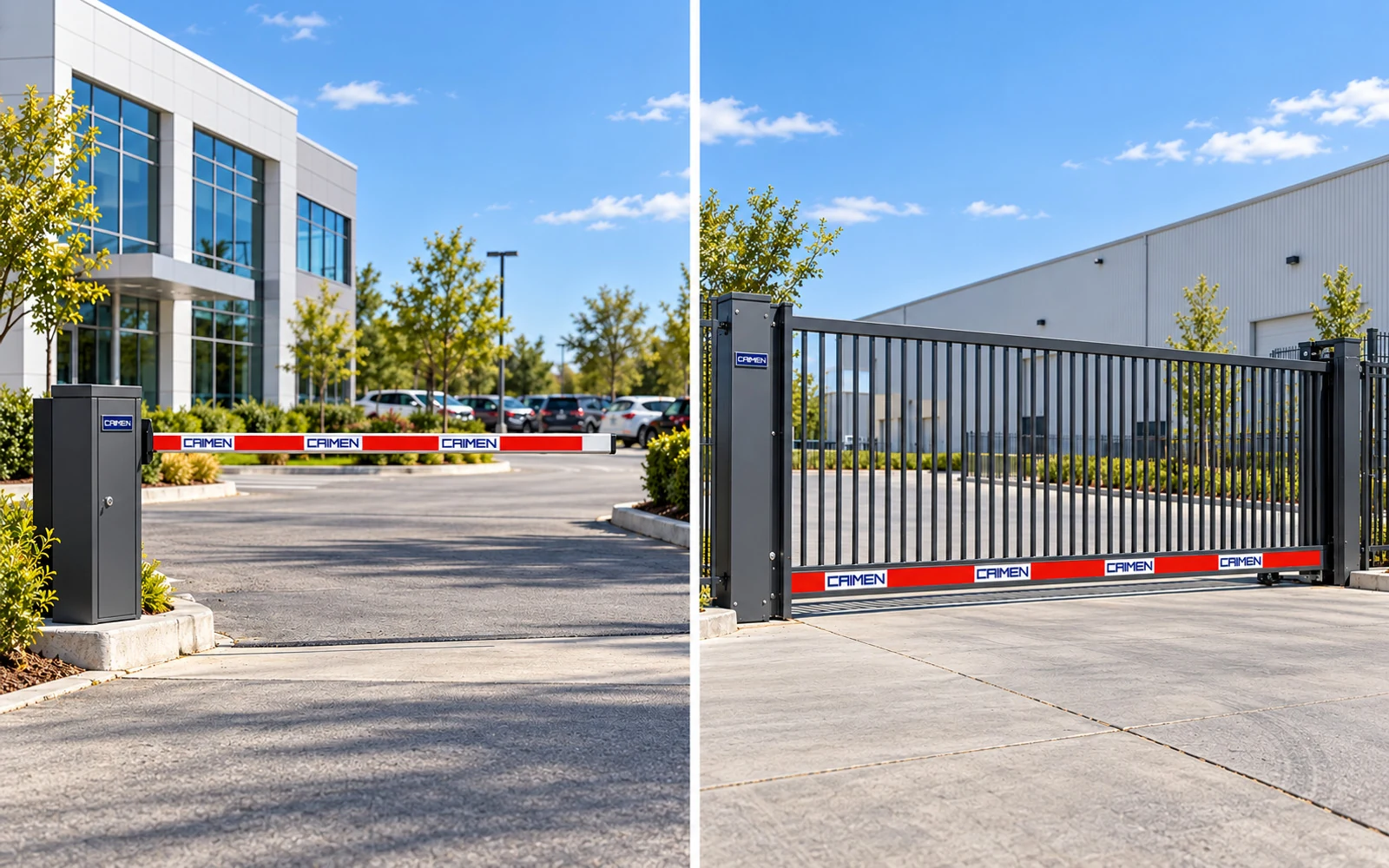
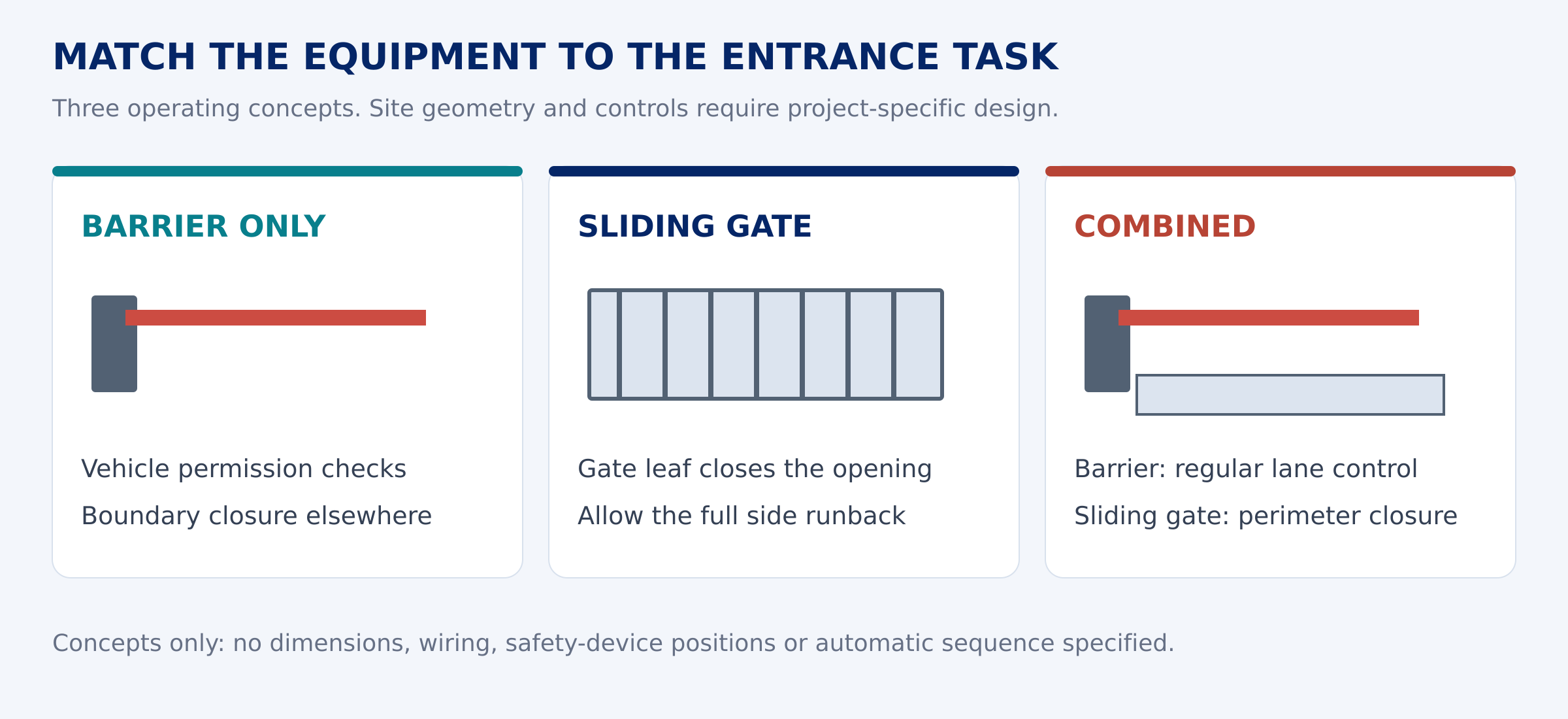
A parking arm gate suits an entrance where the main task is to authorize vehicles and manage their passage through a lane. A sliding gate suits an entrance where a taller gate leaf needs to close the opening in the property boundary. If your site needs frequent vehicle checks during the day and a perimeter closure after hours, using both may be the better arrangement.
At CAIMEN, we start with the entrance layout and operating brief. A parking arm gate, also called a boom barrier or barrier arm gate, and a sliding gate solve different parts of that brief. The choice should follow how the site works, including what must happen when traffic stops for the day.
Parking arm gate vs sliding gate at a glance
| Planning point | Parking arm gate | Sliding gate |
|---|---|---|
| Main task | Manage vehicle passage at a stopping point | Close an opening in the property boundary |
| Moving element | A narrow arm pivots up and down | A taller gate leaf travels sideways |
| Space to check | Cabinet, arm sweep and overhead clearance | Runback, supports and the full leaf travel zone |
| Boundary coverage | Open above and below a standard arm | Depends on leaf height, infill and fence connections |
| Operating duty | Confirm the selected arm and drive configuration | Confirm the selected leaf and drive configuration |
| Typical brief | Managed parking or a credentialed vehicle lane | A yard or compound requiring perimeter closure |
| Using both | Frequent lane control during operating hours | Perimeter closure at the agreed times |
Choose a parking arm gate for controlled vehicle passage
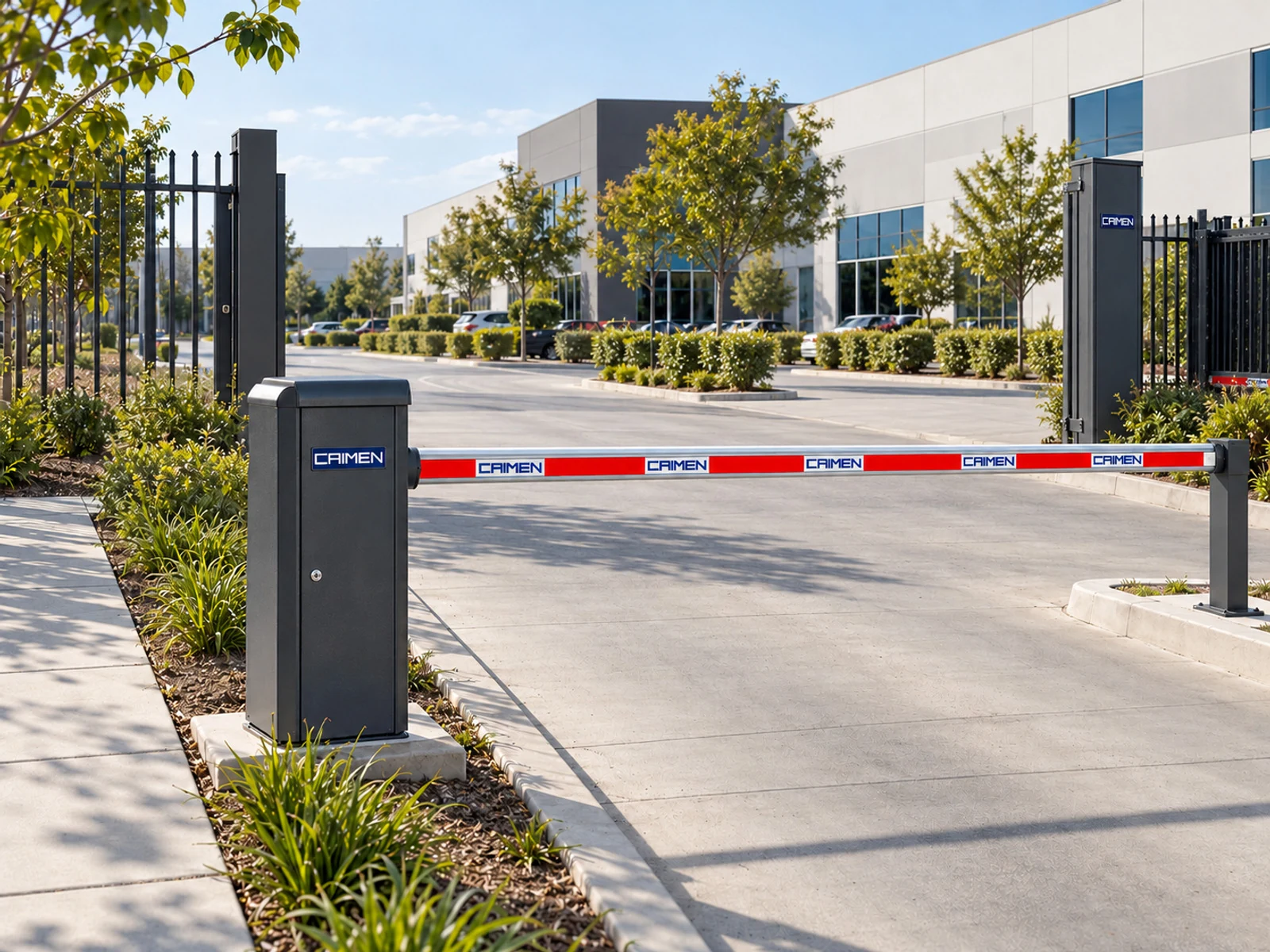
A boom barrier gives a driver a visible stopping point while a ticket, credential or host approval is checked. It can suit office parking, staff car parks and managed visitor lanes where the surrounding boundary does not depend on the arm for its closure. Select the reader or intercom around the actual user process.
The space above and below a standard arm remains open. A pedestrian can walk around an inadequately bounded lane, and an arm alone does not create a continuous fence line. Check the islands, kerbs and adjacent openings as part of the layout.
Ask for the operating duty supported by the selected barrier with its actual arm length and accessories. A short opening time does not establish how many vehicles the entrance can process: credential checks, driver response and the closing sequence also take time.
Choose a sliding gate when the boundary opening must close
A sliding gate moves a gate leaf across the entrance. Its height and infill can continue the surrounding fence design and provide a more complete physical boundary than an open barrier arm. For a warehouse yard, equipment storage area or private compound, that closure may be a central requirement.
An ordinary sliding gate is not automatically a crash-rated vehicle barrier, and a closed leaf does not by itself prevent climbing or tailgating. Specify the threat you need to address, the fence interfaces and any tested security performance separately.
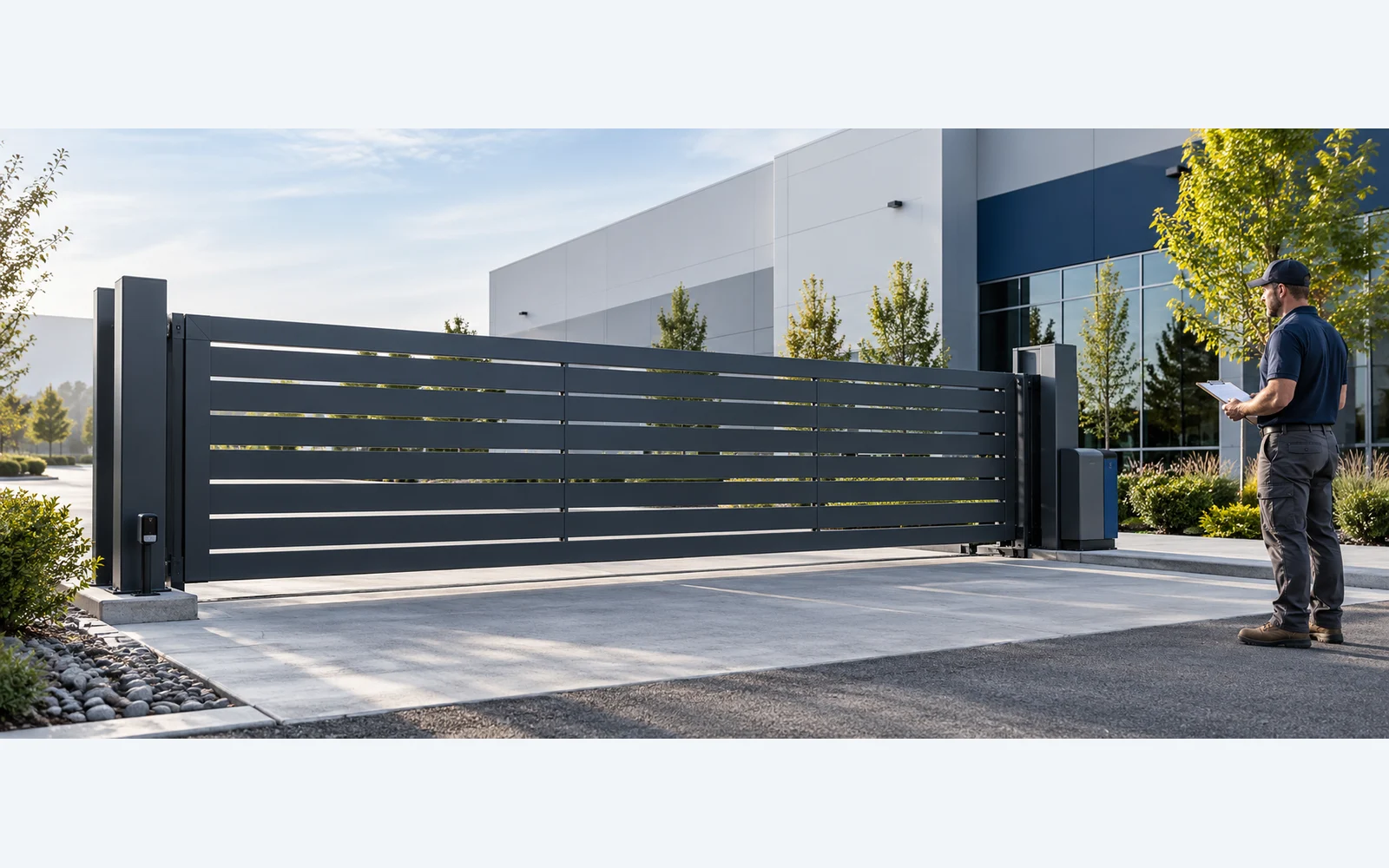
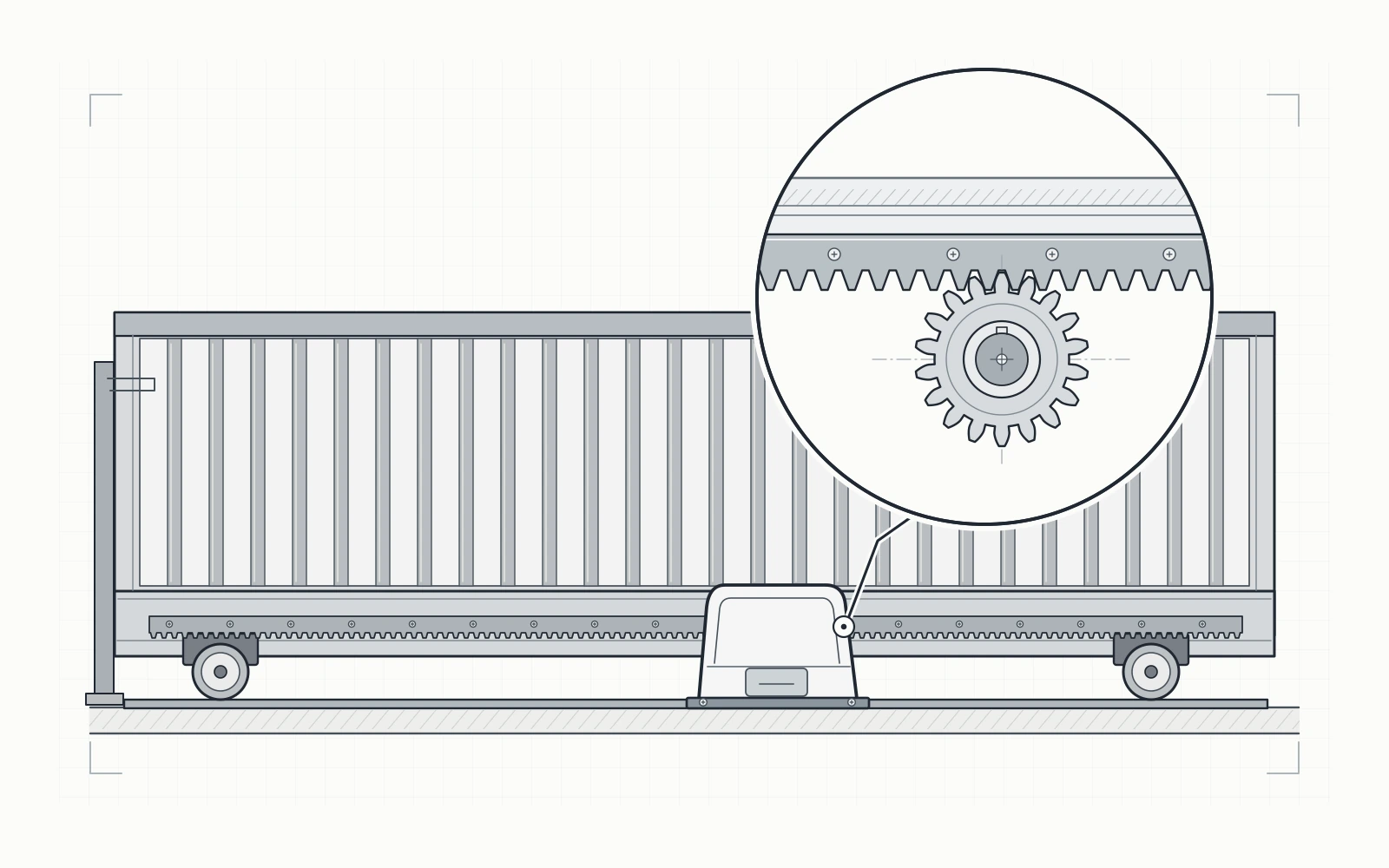
Our aluminum cantilever sliding gates move without a ground rail across the driveway. The gate still needs engineered supports, foundations and enough space beside the opening for the complete moving leaf, including its counterbalance section. A trackless driveway does not remove those site requirements.
Use both when daytime access and after-hours closure differ
One possible arrangement keeps the sliding gate open during staffed hours while a barrier manages individual vehicle permissions. The sliding gate closes when the site changes to its after-hours operating mode. This separates frequent lane control from the larger perimeter closure.
The positions and control sequence need to work together. Check the longest vehicle, any trailer, reader position and the space between the devices. A vehicle waiting at the arm must not sit in the sliding gate travel zone or obstruct a public road. Set the distances from the site plan and vehicle movements, rather than using a generic gap.
Define how the equipment confirms a clear passage, handles a failed opening and changes operating modes. Sharing an access credential does not establish a safe sequence between two machines. We review the relevant gate interfaces against the selected equipment and the agreed operating brief.
Check the available space and the peak queue
For a barrier, review the cabinet footprint, arm sweep, raised-arm clearance and any support or folding-arm arrangement. Overhead services and low ceilings can change which arm configuration is suitable. Leave service access to the cabinet.
For a sliding gate, measure the side runback and check it for parked vehicles, walls, services and pedestrian routes. If the available side space is limited, a telescopic sliding gate may be worth reviewing. Its final retraction space and structure still depend on the selected design.
Give the supplier a peak arrival pattern, not only a daily vehicle total. Include delivery trucks, unfamiliar visitors and any two-way movement through one opening. The queue depends on the entire entry process, so test the proposed sequence before agreeing a traffic-capacity claim.
Plan pedestrian access, detection and outages
Provide an appropriate walking route outside the vehicle equipment movement zones. Where a controlled foot entrance is needed, a separate pedestrian gate can be assessed alongside the vehicle entrance. Include cyclists and motorcycle users in the access brief instead of assuming that every vehicle detector will identify them reliably.
The installer needs to assess the moving equipment and specify protective measures for the actual layout. A credential reader checks access permission; it does not establish that the movement area is clear. Confirm the detector coverage, gate travel hazards and the response when a vehicle stops unexpectedly.
Agree the power-loss response and any backup supply before ordering. Also decide who can carry out an authorized manual release, how access works during a communications outage and how emergency access is provided for the project. These arrangements must suit the equipment and local site requirements.
Compare the installed scope and maintenance needs
Compare quotations for the complete entrance. Include foundations, power and cabling, readers, detection, protective devices, commissioning and any recurring software or connectivity charges. For a combined arrangement, include the interface work and testing between the barrier and sliding gate.
Maintenance tasks differ. A barrier needs inspection of its arm, mountings and selected balancing or drive components. A sliding gate needs checks of its supports, guides, drive and travel area, with ground-track cleaning where a track is used. Follow the supplied maintenance instructions and arrange qualified service for adjustments.
Frequently asked questions
Is a parking arm gate enough for a commercial site?
It can be sufficient for managing a vehicle lane when perimeter closure is provided elsewhere or is not required at that opening. If the entrance must become part of a closed fence line, assess a gate leaf and its surrounding boundary as well.
Which option is better for heavy traffic?
Compare the selected equipment at the required peak duty, including the actual arm or leaf size. Then check the credential process, vehicle detection and queue space. Neither product name establishes a reliable vehicles-per-hour figure.
Can a boom barrier stop tailgating?
An arm alone cannot guarantee one vehicle per authorization. Review detection, lane geometry and the complete control sequence. A sliding gate can also remain open long enough for another vehicle to follow, so specify the required access behaviour explicitly.
Can we add a sliding gate to an existing barrier entrance?
Possibly, after reviewing side space, foundations, the vehicle waiting area and the existing controls. Confirm compatibility from the actual equipment documents and allow for a new site assessment and commissioning.
Send CAIMEN your entrance layout
Contact our team with the clear opening width, required gate height, available side space and site photographs or drawings. Include peak arrivals, vehicle types, opening hours and the required after-hours closure. We can review the gate configuration and relevant interfaces around those requirements.