The driveway is already paved and there is no conduit to the opposite post. Can you replace through-beam gate photo eyes with a retroreflective model? Possibly. Verify operator compatibility, the actual mounting distance, and the area the beam needs to protect. A retroreflective model typically needs power on the sensor side only, but the opposite side still needs a stable mount for the reflector.
Check all three conditions together. For example, an installer might move the reflector to a more convenient post to avoid disturbing the pavement. The sensor might still receive the beam, but the beam could now miss the area it was meant to protect. Catch that change on the site plan before mounting the hardware.
How reflector and through-beam gate photo eyes work
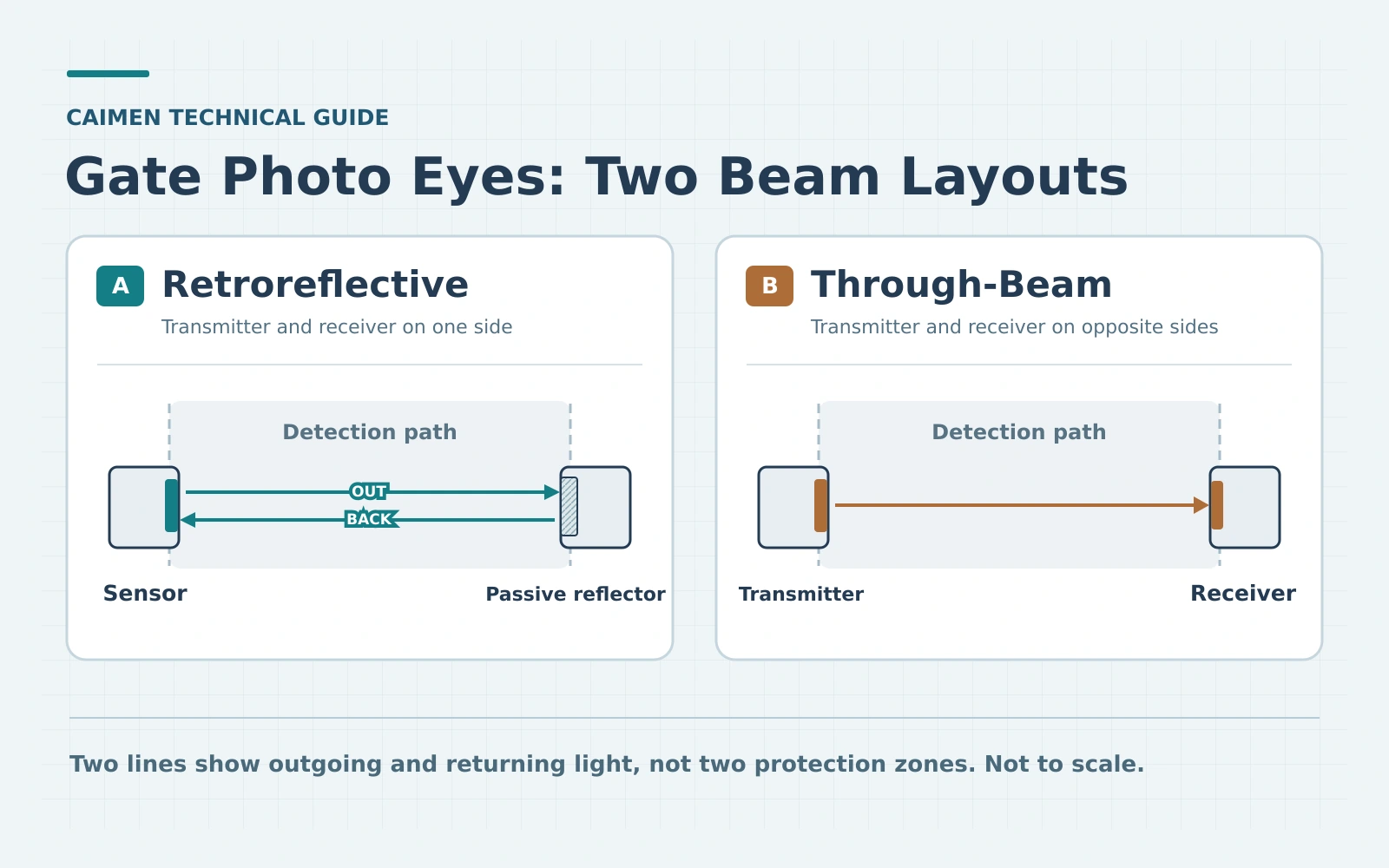
Through-beam photo eyes have a separate transmitter and receiver on opposite sides. The transmitter sends light to the receiver. When an object breaks that path, the sensor changes state. Conventional wired models need power or wiring at both ends, depending on the design. If a model uses a battery-powered component, confirm the operator approves that combination and plan how the component will be serviced.
Retroreflective photo eyes put the transmitter and receiver in one housing. A dedicated reflector on the opposite side sends the light back to that housing. The reflector itself is passive and requires no power. In this context, a gate reflector means the matching optical reflector for the photo eye. Reflective tape on the gate frame serves a different purpose and is not a replacement.
| What to check | Retroreflective | Through-beam |
|---|---|---|
| Hardware at each end | A powered sensor and a matching passive reflector. The outgoing and returning light share the same detection path. | A transmitter and receiver facing one another. Light travels from the transmitter to the receiver. |
| Work on the far side | The reflector does not need a cable across the driveway. Allow for a rigid mount and access to clean and inspect it. | Both ends have active components. Check any existing conduit. If none is available, verify how the selected equipment will be powered, wired and serviced. |
| Distance and alignment | Measure from sensor to reflector. Check the model's permitted range and confirm that the reflector is approved for it. | Measure from transmitter to receiver. Once both units are mounted, verify alignment and operation as the manufacturer directs. |
| Outdoor maintenance | Inspect the sensor lens, reflector and mounts. If faults recur after rain, condensation or dust buildup, note the conditions. | Inspect both lenses, the mounts and power at both ends. Movement at either post or bracket can throw off alignment. |
Can you switch to a reflector on an existing driveway?
- Identify what the existing beam protects. Mark the gate's direction of travel, posts, runback area and sensor locations. Do not move the beam to a different line simply to use an available post. Our guide to sliding gate pinch points explains where to look for hazards around a moving leaf.
- Check the operator manual as well as the sensor manual. Record the operator model, control board revision and original photo-eye model. Confirm which devices and monitoring methods the operator accepts. A sensor that powers up and reports a blocked beam may still be incompatible with how the operator checks for faults.
- Measure between the proposed mounts. The relevant distance is between the devices, which may differ from the driveway's clear opening. Check the selected model's minimum and maximum distances. Make sure the mounts stay steady when the gate moves, and check whether parked vehicles, plants or fixed objects can obstruct the intended beam.
- Agree on the checks before deciding whether to cut the pavement. Have the installer verify the required protection, the operator's response in each relevant direction, and fault monitoring according to the manuals and the site plan. If a reflector cannot cover the right area under those conditions, compare wiring to the far side or another protective arrangement approved for the operator. On a new entrance, use our pre-pour conduit checklist to plan the cable route and service access before paving.
Can you replace a cracked or missing gate reflector on its own?
If the manufacturer supplies an approved replacement reflector, the sensor is working and the mount and light path are sound, ask the installer to assess a reflector-only replacement. Identify the photo-eye model, not just the gate operator. Check the reflector type, size and bracket against the parts list. Matching screw holes do not establish optical compatibility.
After replacement, verify alignment and protective operation according to the manual. Some devices report alignment or signal quality, which can distinguish no return signal from weak alignment. A status light alone is not a handover test. The installer should verify how the operator responds to an interrupted beam and to a device fault, using the manufacturer's procedure and project requirements.
What should you record if the gate won't close after rain?
Start with what the gate actually does. Does it refuse to start closing, or does it move and then stop or reverse? Does it happen only after rain or when condensation forms? From outside the travel area, note visible dirt, moisture or misalignment at the lens or reflector, along with any controller message and the time of the fault. Have the installer check power, signal quality and the mounts before replacing parts. Our guide to an automatic gate that won't close covers other reasons a closing cycle may be interrupted.
If an entrapment protection device is unreliable, take the gate out of automatic service and arrange an inspection. Do not bypass the sensor, increase the operator force or move the beam to clear a fault indication. A clear beam tells you only that its path is unobstructed. When comparing photo eyes, ask separately: Which layout fits the site's wiring, and which areas still need other protective measures?
Frequently asked questions
Does a retroreflective gate photo eye need any wiring?
Yes. The passive reflector does not need power, but the sensor typically needs power and a connection to the operator's required monitoring interface. Avoiding a cable across the driveway does not make the whole system wireless.
Which type can work over a longer distance?
Compare individual models. Check the permitted span, environmental conditions and mounting requirements against the actual installation distance. The maximum listed range does not guarantee that range at every site.
Can I use ordinary reflective tape or a mirror?
No. Use a reflector specified or approved by the sensor manufacturer. After replacement, have the installer verify operation according to the manual.
Can one pair of photo eyes protect an entire sliding gate?
A photo eye detects an object only where it can interrupt the beam. Assess the runback area, post gaps and other hazards in each direction separately. The complete gate design determines the number, type and placement of protective devices.
Do I need a reflector if the driveway already has conduit to the opposite side?
No, not just to eliminate far-side wiring. If the current through-beam devices match the operator and protective design and work reliably, weigh actual maintenance needs, spare parts and the cost of verifying any replacement before changing the setup.