If the existing sliding gate operator supports only a mechanical limit switch, start with a manufacturer-approved mechanical replacement. A magnetic version in the same product range does not make the two systems interchangeable. Confirm what the operator and control board support before comparing the trigger mechanism, site conditions and availability of spare parts.
Say a factory gate always opens normally, but on closing it sometimes stops short of the receiver and sometimes stops much closer. Record two things: did the control board register the close-limit input, and where did the gate come to rest? The first points you toward the trigger and its signal. The second may also involve deceleration, braking or resistance along the gate's travel.
Mechanical limit switches use contact; magnetic switches do not
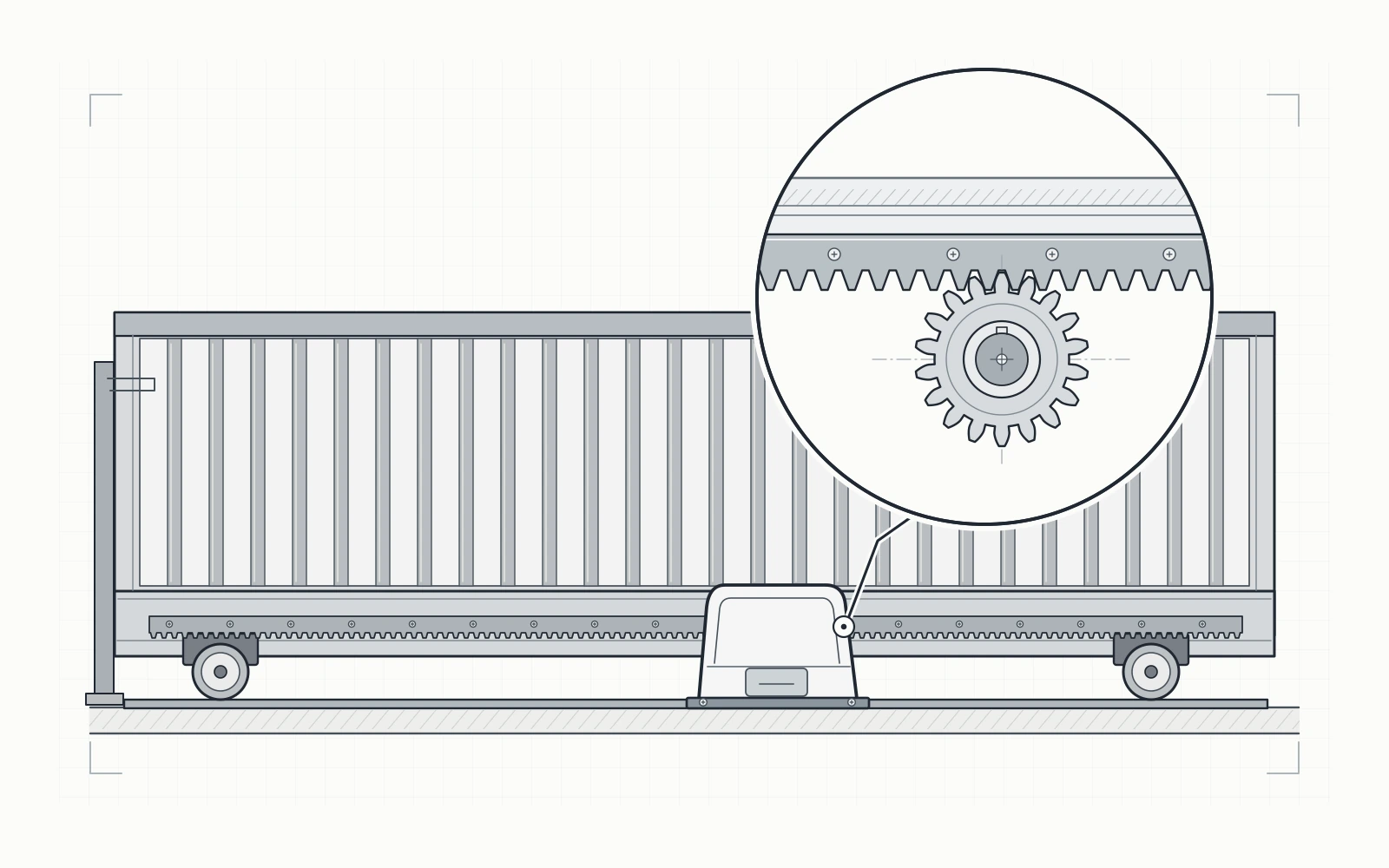
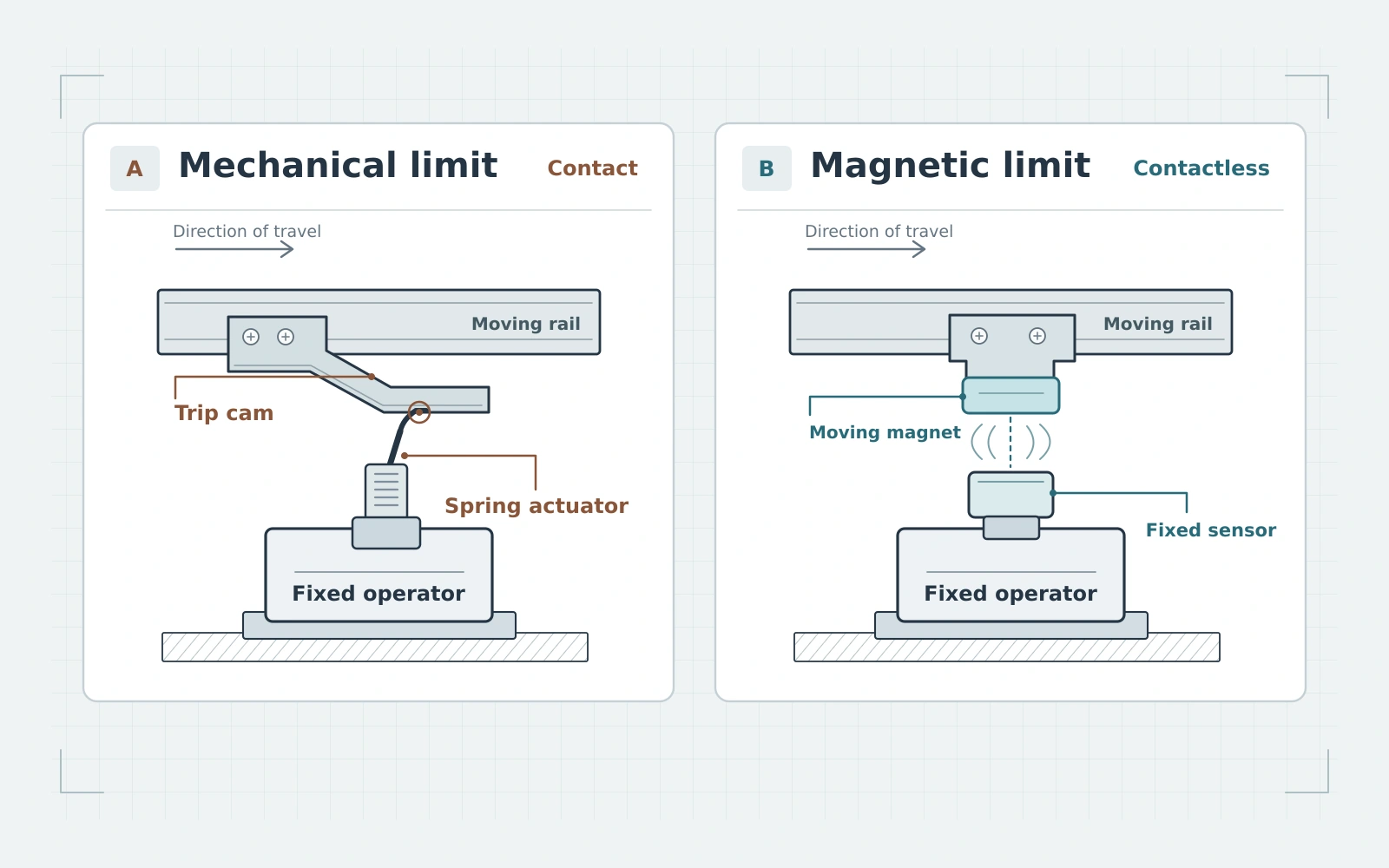
On a typical rack-driven gate, an opening trigger and a closing trigger move with the gate, while the detector stays at the operator. With a common spring-type mechanical limit switch, a cam deflects a spring actuator and changes the state of a microswitch. With a magnetic limit switch, a bracket-mounted magnet passes within range of a fixed sensor without touching it. The illustration shows one end of travel for each type. Use the operator manual for the actual mounting position, orientation and permitted gap.
| What to compare | Spring-type mechanical limit | Magnetic limit |
|---|---|---|
| How it triggers | A moving cam makes contact with the spring actuator and operates the microswitch. | A moving magnet passes the fixed sensor, and the controller registers the corresponding limit input. |
| What to inspect | Look for a loose, bent or misaligned cam and an actuator that sticks or fails to return. | Check bracket movement, sensing distance and orientation. Confirm whether the manufacturer distinguishes the open and close magnets or specifies polarity. |
| Where each makes sense | Keep the original type if approved parts are available, the mechanism is easy to inspect and it has been working reliably. | If ice repeatedly jams the spring actuator, compare approved magnetic options. A contactless sensor removes that specific failure point, but bracket movement or sideways gate play can still cause a missed signal. |
Record three positions separately
If the controller displays input status, the installer can use its diagnostics as described in the manual. Some operators begin slowing down before the limit is detected. Do not assume the gate will stop as soon as the signal changes.
Where the gate is when the board registers the open or close limit.
Where the gate comes to rest, and whether it meets the required opening or closing position.
The fixed boundary of travel. Check its location against the operator's installation drawing.
If the system has a separate mechanical stop, verify its position and the required clearance in the installation drawing. A gate hitting that stop does not prove the limit works. Limit switches do not replace photo eyes or safety edges. If the gate strikes the stop, cannot stop reliably or moves uncontrollably, take automatic operation out of service and have the installer investigate.
Four checks before replacing a sliding gate limit switch
- Operator and control board. Record the complete operator model, board revision and manual revision. Verify the approved spare part or conversion kit; two operators with the same housing can use different limits.
- Control interface. Check the specified signal type, supply and terminal assignments. A matching plug does not establish compatibility. Do not jumper a limit input to run a test.
- Trigger hardware and position. Confirm the mounting surface, opening and closing orientation, and the specified trigger travel or sensing gap. Follow the model's instructions for magnet orientation and polarity where applicable.
- Recommissioning. Check whether the operator requires a new travel-learning cycle or end-position setup. Follow the manufacturer's procedure to verify the limit input, final stop and protective devices in both directions, even if only one end was repaired.
Where to look when the stopping position changes
| What you observe | What to record or check first |
|---|---|
| The closing limit is sometimes missed | Record whether the close-limit input changes. Check the trigger position, mounting and conditions at that end. A reliable opening limit does not rule out a closing-side fault. |
| The board sees the limit, but the stopping position varies | Record the trigger point and final stop separately. Check deceleration, braking, travel learning and local resistance along the gate's path before moving the trigger. |
| The gate stops or reverses before the limit | Record the relevant indicator or diagnostic message and separate a safety input or obstruction from a limit issue. See our guide to an automatic gate that won't close. |
| The gate clicks or shifts at the same spot mid-travel | Check the guides, supports and drive. If the gate moves sideways or catches as a rack joint passes the pinion, see our full-travel rack and pinion alignment guide. |
When reporting a fault, include the operator model, direction of travel, limit input status, final stop position and whether the symptom coincides with rain, snow or low temperatures. Before touching parts, removing a cover or repositioning hardware, have the installer isolate the relevant power sources and secure the gate against unintended movement as the manual requires. If you need help identifying components, see our visual guide to sliding gate parts.
Frequently asked questions
Can I replace a mechanical limit switch with a magnetic one?
Only if the manufacturer supports the conversion for your exact model. Verify the magnet, sensor, brackets and control interface as a system.
Does an encoder mean the gate doesn't need limit switches?
Not necessarily. Some operators learn travel positions from position feedback; others still use physical limit switches for end-of-travel signals. Follow the model's design and leave the original switches in place unless the manufacturer specifies otherwise.
How close should the magnet be to the sensor?
There is no universal gap. Use the specified sensing range, mounting reference and orientation, then verify reliable detection at both ends according to the manual.
Can moving the cam make the gate close more tightly?
First find out why the gate stops early. Safety inputs, resistance, controller settings and the receiver position can all affect the result. Moving the cam without identifying the cause can let the gate travel beyond its intended stopping point.
Is a magnetic limit switch always better outdoors?
No. Compare enclosure protection, operating temperature, mounting stability and spare parts. If an existing mechanical setup runs reliably and approved parts are available, there is no reason to change it solely because magnetic detection is contactless.