A sliding gate quotation can list rollers, a track, a rack and a receiver without explaining how they fit together. Similar names can also describe different hardware. A wheel that travels on a driveway rail does a different job from a carriage fixed beside a cantilever gate.
At CAIMEN, we manufacture aluminum gate systems for residential and commercial entrances. This guide explains the main sliding gate parts in the terms buyers need: what each part does, which arrangement uses it, and what to confirm before ordering.
Identify the support system first
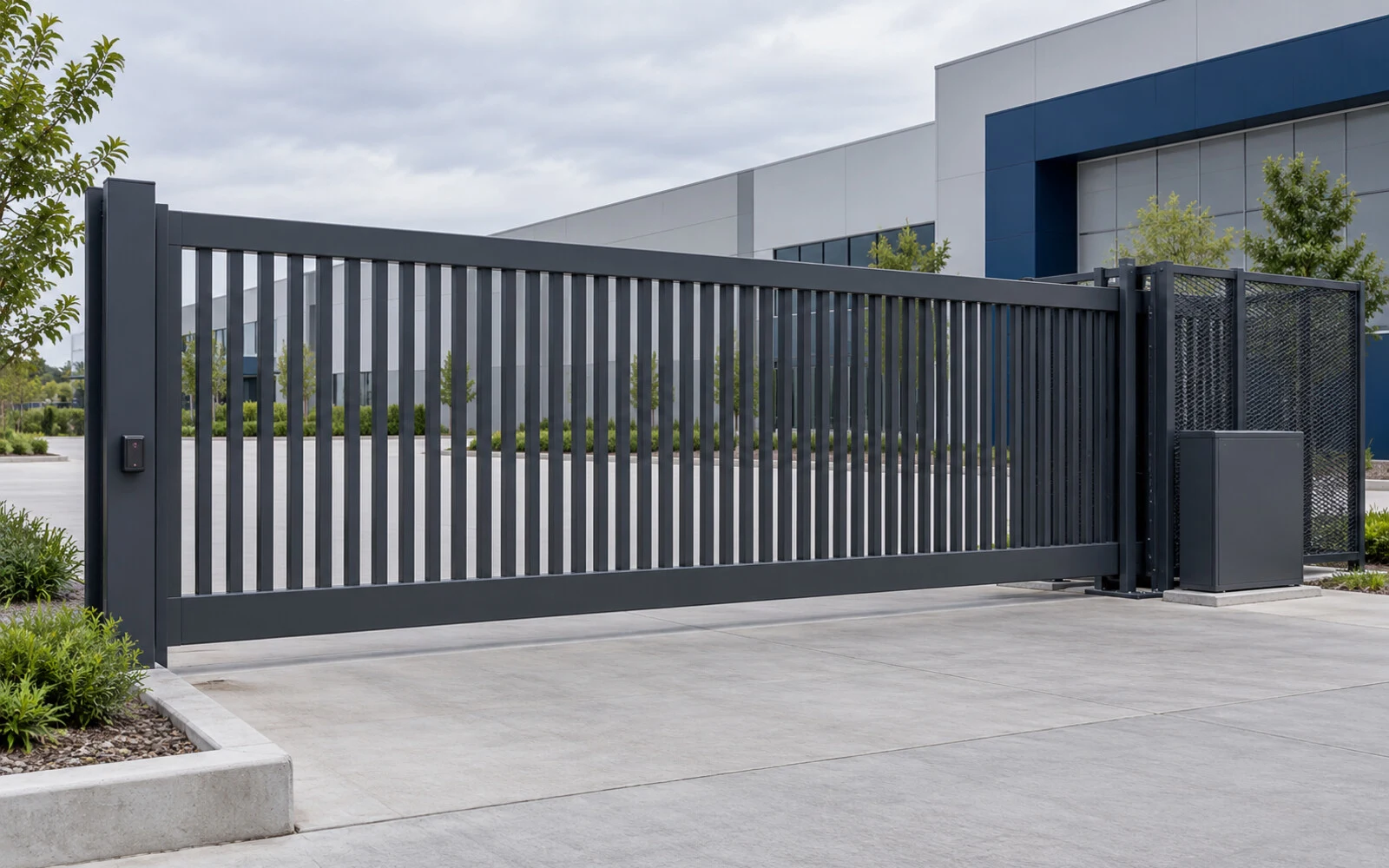
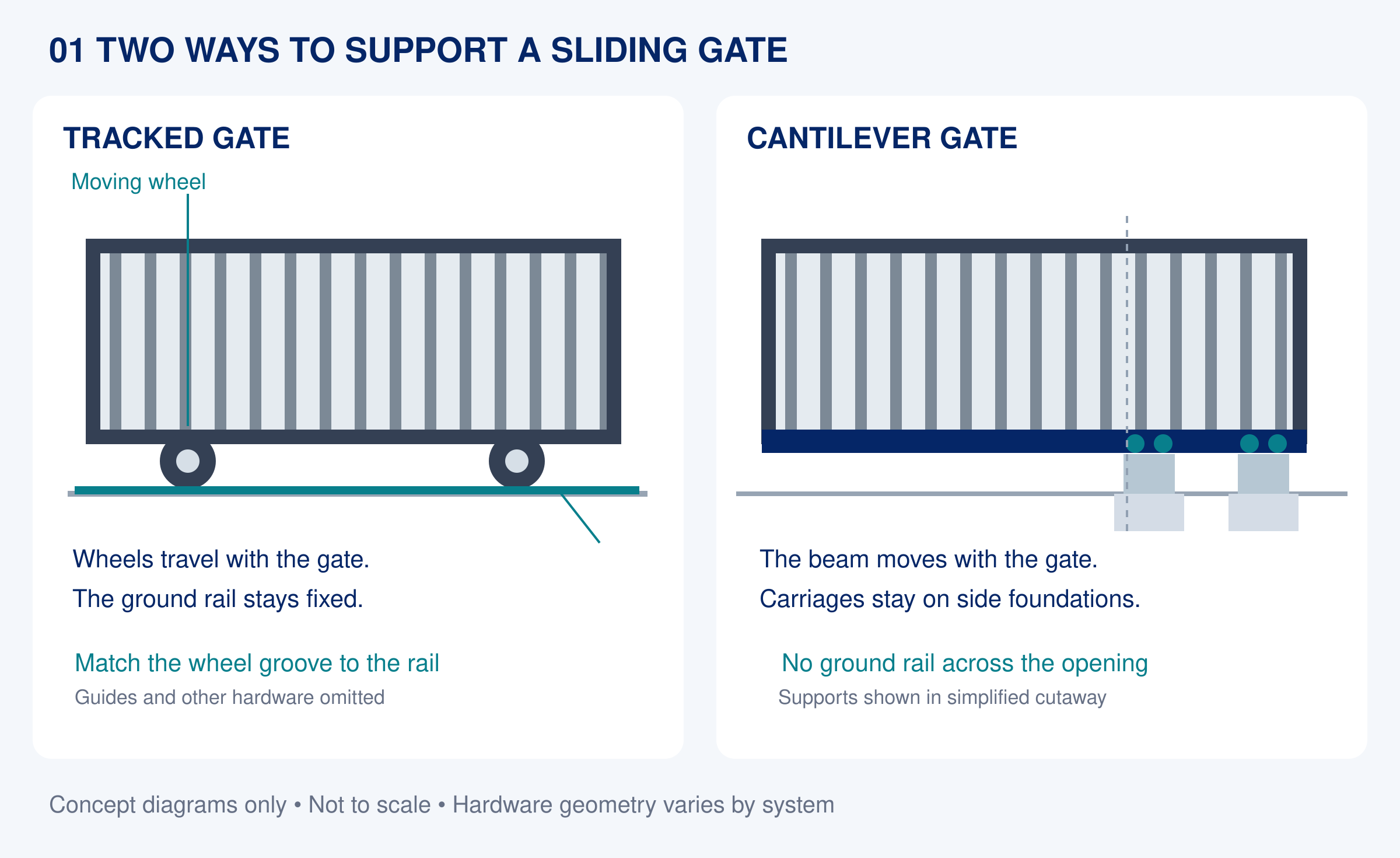
A tracked sliding gate has wheels attached to the moving leaf. Those wheels travel along a ground rail. In a bottom-beam cantilever system, the running beam is attached to the leaf and travels over fixed roller carriages beside the opening. There is no continuous running rail across the driveway.
The support arrangement determines the running hardware you need. For background on the cantilever principle, read our guide to how a cantilever gate works. The diagrams here cover a conventional tracked gate and a bottom-beam cantilever gate; other sliding systems use different arrangements.
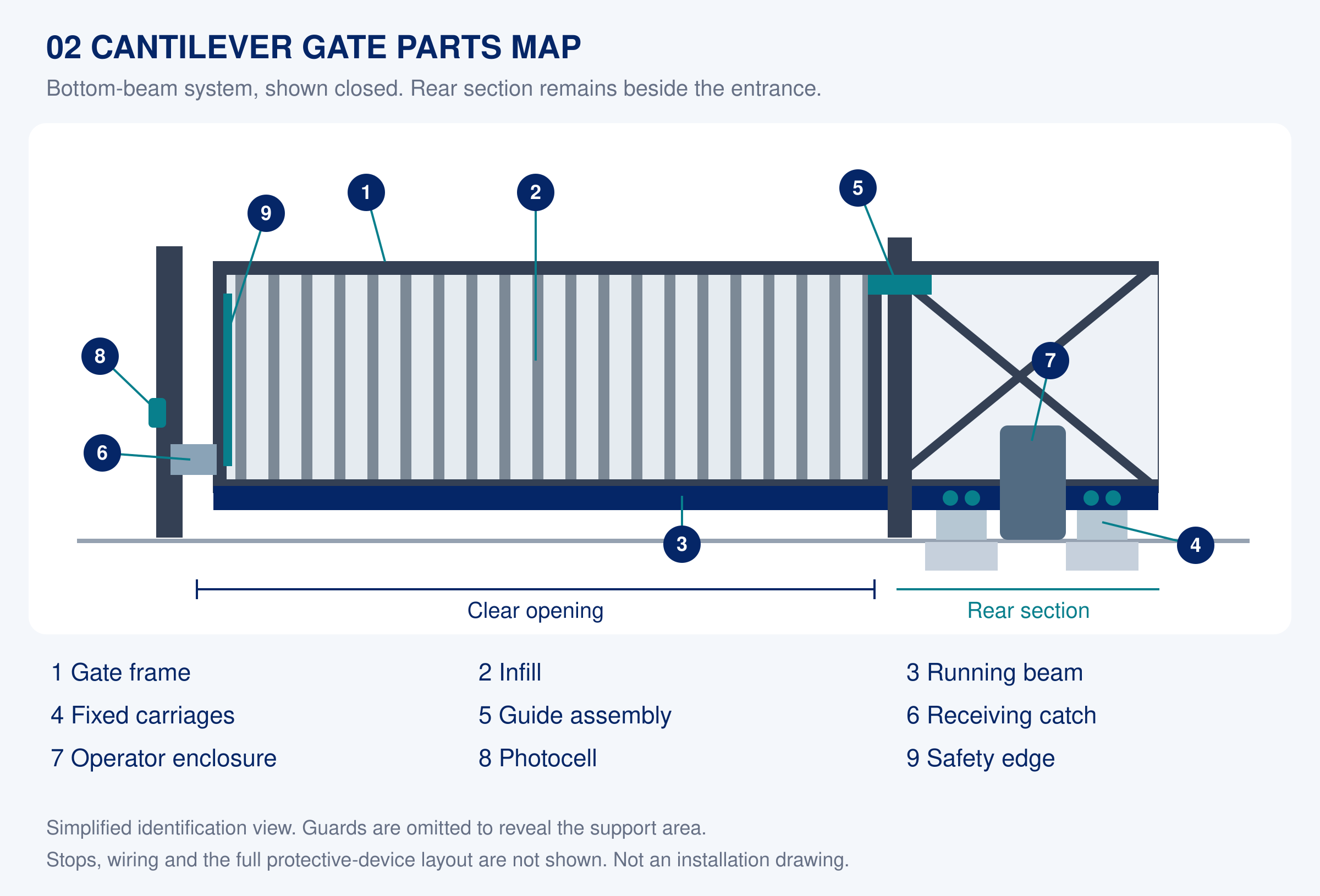
A visual map of the main sliding gate parts
Use the numbered map to locate the parts, then match the names to the supplier’s drawing and bill of materials. The map shows a generic cantilever arrangement. An actual project may combine components inside a drive column or use a different guide and receiving layout.
1. Gate frame and infill
The frame forms the structure of the moving leaf. Infill fills the space within it, using slats, bars, mesh or panels. Buyers often focus on the infill because it determines privacy and appearance, but it also affects the gate’s weight and exposure to wind.
Confirm the complete leaf dimensions and the specified infill before approving the hardware. Changing an open-bar design to a solid panel after selection calls for a design review. For our aluminum gates, the frame, infill and finish form part of the agreed project configuration.
2. Ground wheels and rail, or a running beam and carriages
On a tracked gate, the wheel groove and rail profile must match. Wheel diameter alone does not establish compatibility: the bearing arrangement, mounting dimensions, load rating and rail geometry also matter.
On a cantilever gate, the beam and carriages form a matched running system. The carriage has several rollers on a fixed mounting assembly; the beam moves over them. Check the manufacturer’s system reference and selection limits before combining parts. A quoted load figure on one component is not approval for every gate built around it.
If the proposal includes several beam or carriage sizes, ask which gate dimensions and complete leaf weight support the selection. Our article on cantilever gate calculation inputs explains the information needed for that review.
3. Guides, receiving catches and stops
Guide rollers or guide assemblies help keep the leaf aligned during movement. Their location and load-carrying role depend on the system. Do not substitute a guide roller for a specified supporting carriage because the two look similar in a catalogue.
A receiving catch locates the leading end when the gate closes. Some receiving arrangements also support the closed gate; confirm that function in the drawing. Mechanical stops limit physical travel where specified. The operator’s electronic end-position control has a separate job, so the proposal should identify both arrangements.
Understand what the operator actually drives
The operator supplies movement through a transmission such as rack-and-pinion or chain drive. In a rack-and-pinion arrangement, the toothed rack is attached to the gate and meshes with the operator’s pinion. The rack transmits driving force; the selected wheels or cantilever supports carry the gate.
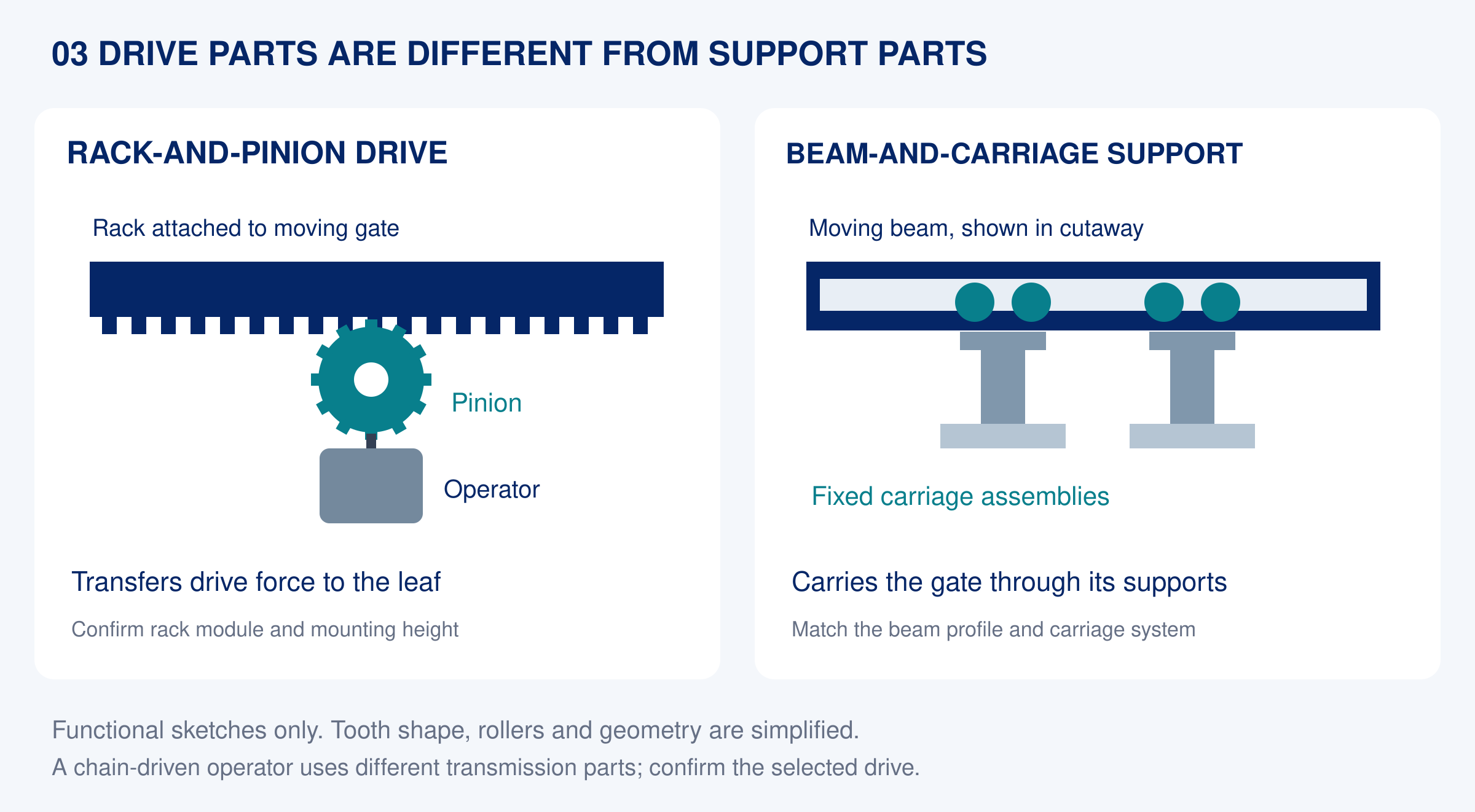
For rack-driven equipment, confirm the rack module, material, fixing arrangement and mounting height against the selected operator. A chain-driven operator needs its own compatible chain, attachments and associated hardware. Neither transmission type should be assumed from a photograph of the enclosure.
When comparing automatic sliding gate parts, ask for the operator model and its intended duty as well as the gate weight it is selected for. Daily use, peak operating periods, speed requirements and the full gate configuration belong in that discussion. A larger motor does not correct incompatible running hardware or a poorly aligned gate.
Separate access controls from safety equipment
A remote receiver, keypad, card reader or access-control interface sends an operating request. Photocells and safety edges provide inputs used by the protective system. A reader that opens the gate does not demonstrate that the safety functions have been tested.
Photocells detect interruption of a beam at their installed position. A safety edge detects contact along the fitted edge. Device type, location, monitoring and the operator’s response must suit the complete entrance. The correct number of devices cannot be established from a generic parts list.
For an automated gate, have the installer define the protective measures and commissioning checks for the actual site. When requesting a quote, ask for the safety devices to be named individually, together with any controller or interface modules needed to connect them.
What to check before ordering parts or a complete gate
| Item | Question for the supplier | What to obtain |
|---|---|---|
| Running hardware | What is the exact beam/carriage or wheel/rail system? | System reference and compatible component list |
| Gate dimensions and loading | Which leaf size, weight and infill were used for selection? | Approved configuration and selection basis |
| Drive package | Which operator and transmission are included? | Model, duty requirements and matching drive parts |
| Controls and protection | Which devices and interfaces are supplied? | Named devices, compatibility and site commissioning scope |
| Mounting and site work | Who supplies anchors, foundations and electrical work? | Included/excluded schedule and installation documents |
| Replacement support | How will parts be identified after delivery? | Parts list, project reference and equipment identification |
For replacement parts, send the existing part number, gate and operator identification, clear photographs, and relevant dimensions. Have measurements taken safely by an appropriate person. An unmarked roller photographed from one angle is rarely enough to confirm a replacement.
For a new gate, confirm whether the quotation covers the structure only, a hardware kit, or a configured automated system. List foundations, anchors, power supply, field cabling, installation and commissioning as included or excluded items. Our cantilever installation planning guide covers the site preparation side.
Questions buyers ask about sliding gate parts
Are sliding gate rollers universal?
No. Running wheels, guide rollers and cantilever carriage rollers have different roles and geometry. Match the replacement to the system reference, mounting details and applicable ratings, not appearance alone.
Is a cantilever beam the same as a ground track?
No. In the bottom-beam arrangement shown here, the beam travels with the gate over fixed carriages. A ground track stays on the driveway while the gate’s wheels move along it. A supplier may use “track” for either profile, so ask which arrangement the term describes.
Does a gate hardware kit include the motor?
It depends on the supplier’s stated scope. A kit may contain only running hardware. Request an itemized list identifying the operator, transmission, controls, safety devices and mounting accessories that are included.
Can I use a cantilever carriage on a tracked gate?
It is not a direct wheel replacement. The two arrangements support the leaf differently. Converting a gate requires a reviewed structure, compatible running system, support layout and foundations.
Discuss your sliding gate configuration with CAIMEN
For a new project, explore our aluminum cantilever sliding gates, then send our team your entrance details. Include the clear opening, gate height, available side space, preferred infill and expected use. If you need a replacement for an existing CAIMEN gate, include the project reference and photographs so we can review the relevant configuration.