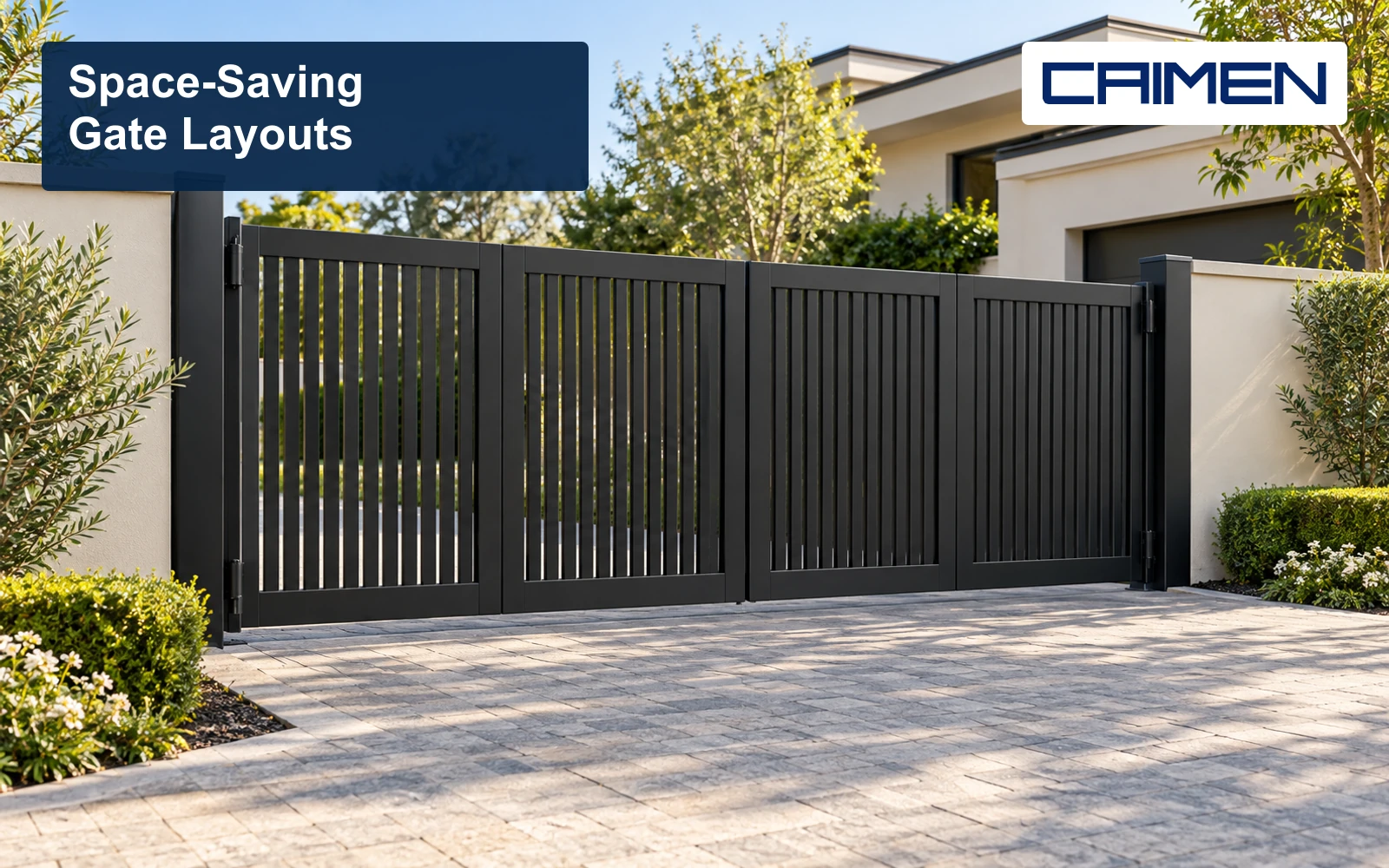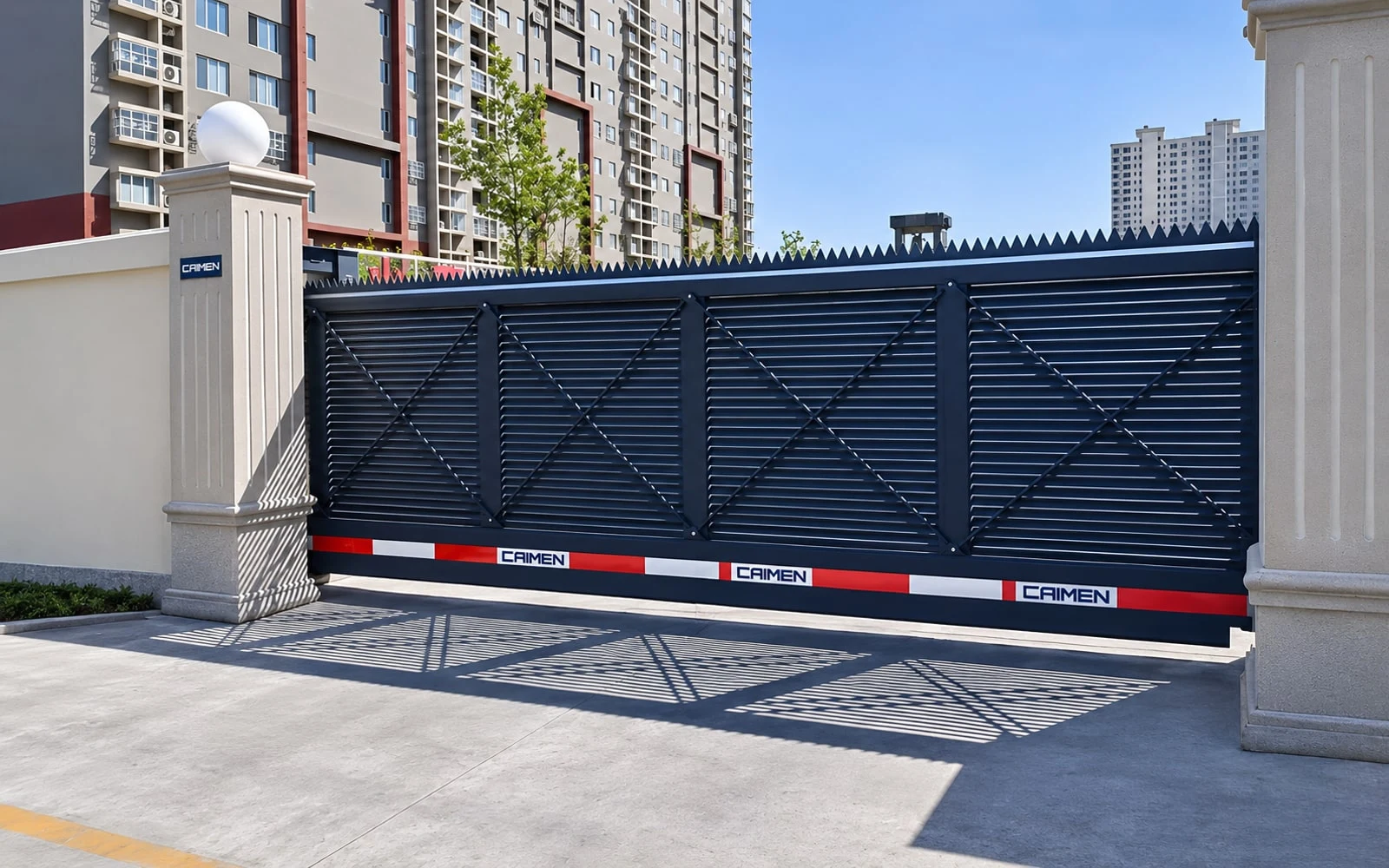
For a residential driveway with a straight approach, 10–12 ft (3.05–3.66 m) of clear opening is a useful starting range to check for a passenger car. For a full-size pickup, a van, or a gate you have to turn through from a narrow road, start by checking 14–16 ft (4.27–4.88 m). These are planning ranges, not minimums. The right width depends on the widest vehicle you expect and how it lines up with the gate.
Measure the clear opening with the gate fully open
The clear opening is the narrowest unobstructed width a vehicle can use at the gate when it is fully open. Start with the distance between the inside faces of the posts or piers. Then check for anything that projects into that space: a receiver, a protective bollard, or part of a swing leaf that stops short of clearing the opening. Check at the heights that matter to the vehicle, including mirror height.
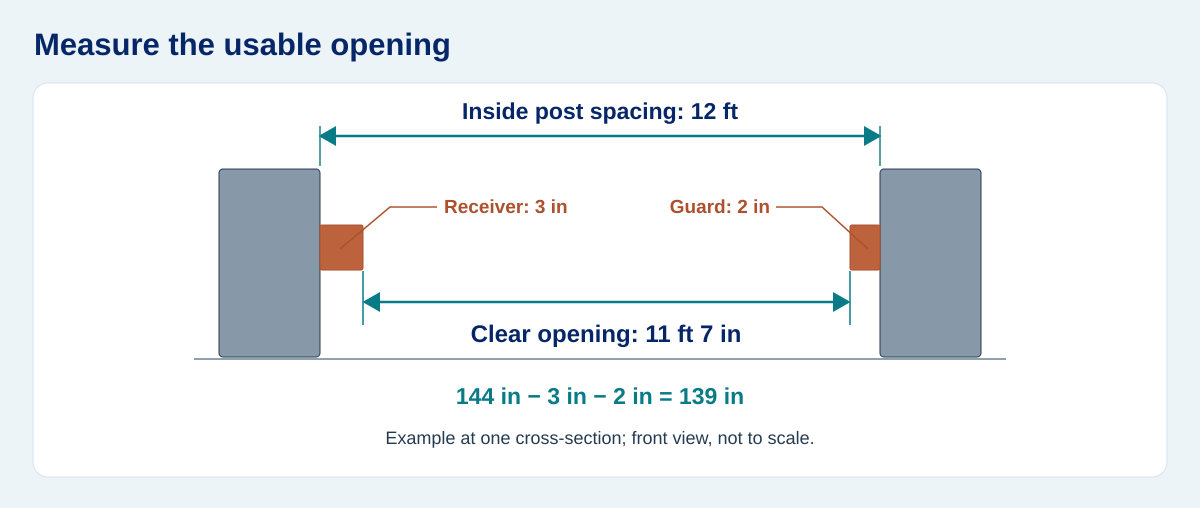
Say the inside faces of the posts are 12 ft (3.66 m) apart. If a receiver projects 3 in from one side and a fixed guard projects 2 in from the other at the same cross-section, the usable width there is 11 ft 7 in (3.53 m). That is the dimension to use at that pinch point. Projections at different positions along the driveway should be checked where they occur; subtracting every projection from one measurement can give a misleading result.
A gate’s listed size can refer to the panel, the intended opening, or another measurement in the manufacturer’s drawing. Keep three figures separate: the clear vehicle opening, the inside distance between posts, and the physical length of the gate leaf. This matters especially with cantilever gate layouts, where the panel extends beyond the opening to reach its supports.
A straight approach and a turn need different checks
When the vehicle is lined up before it reaches the gate, check its widest point in the configuration you actually drive, usually with mirrors out. Leave room on both sides for normal steering variation. For a straight approach, an 8 ft wide vehicle centered in a 12 ft clear opening has 2 ft on each side. That simple check only applies when the vehicle is straight and centered.
If the vehicle is still turning as it reaches the gate, the front outside corner and the inside rear wheel follow different paths. A long wheelbase or a trailer can make the difference more noticeable. Look at both directions of travel. A gate that is easy to enter from one side of the street can be harder to use from the other side or when leaving the property.
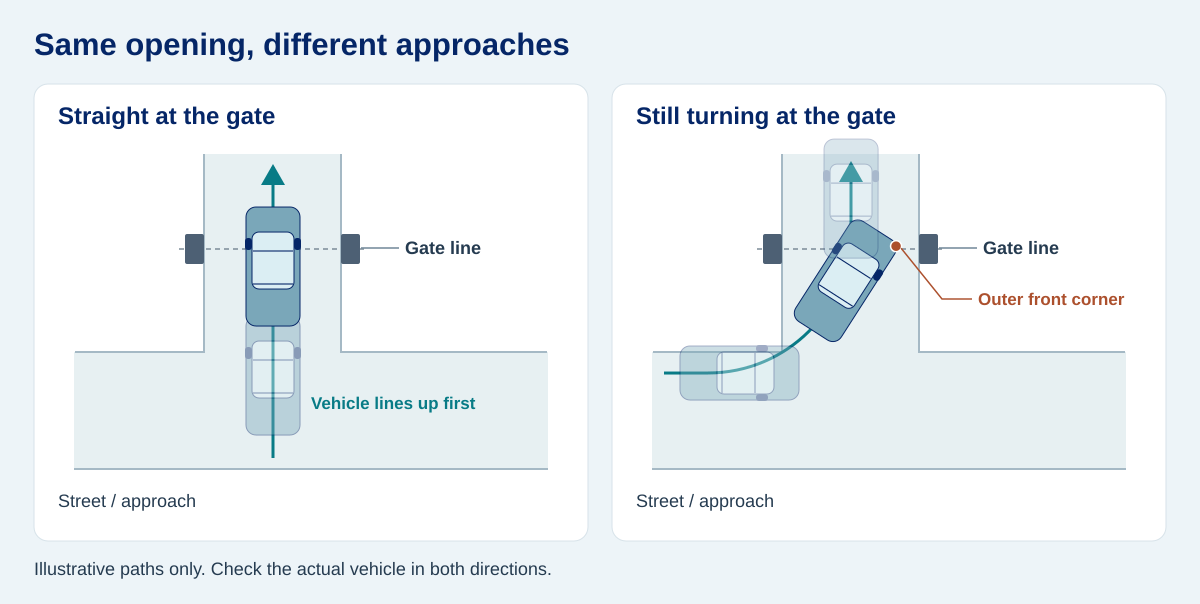
Mark the proposed gate line on a site sketch. Include the road edge, the curb or wall, and anything that limits where the driver can begin the turn. If the front corner or rear wheel would pass close to a post, compare a wider opening with moving the gate farther into the property so the vehicle has more room to straighten. For a tight entrance that serves long trucks or trailers, have the actual vehicle path checked on a scaled plan before fixing post locations.
Which driveway gate width should you check first?
Use these ranges to mark out a first layout. They refer to usable vehicle clearance, even when a gate catalog uses the same numbers for nominal panel sizes.
| Vehicle and approach | Clear width to check first | What to verify |
|---|---|---|
| Passenger car, straight approach | 10–12 ft (3.05–3.66 m) | Mirror width and the narrowest point at the gate. |
| SUV or pickup, straight approach | 12–14 ft (3.66–4.27 m) | Check with mirrors out; wide towing mirrors can change the result. |
| Full-size pickup or van, or a tight turn | 14–16 ft (4.27–4.88 m) | Check the turn, curb, posts and space to straighten. |
| Long truck, camper or trailer | Check the actual vehicle path | Use the vehicle dimensions and the approach geometry to verify the opening. |
Include vehicles you expect to enter, even if they come less often: a contractor’s van, a camper, a trailer, or a delivery truck. If the drive must accommodate emergency or other regulated access, check the local requirements before adopting a residential planning range.
Check where the open gate goes
A wider opening has to fit the gate’s motion as well as the vehicle. On a swing gate, check where the open leaves stop and whether the hinge, leaf edge or operator arm sits near the vehicle path. If the driveway rises behind the gate, check ground clearance throughout the swing. The gate may have room to stand fully open on paper and still meet the paving on its way there.
A sliding gate needs room to retract beside the opening. If it cannot travel far enough, part of the panel may remain in the drive. A pair of center-opening sliding gates divides that travel between two sides, so both sides need checking. If the proposed opening and the space for the open gate compete for the same area, compare layouts for limited side space before moving the posts.
Frequently asked questions
Is a 12-foot driveway gate wide enough?
A 12 ft clear opening is a reasonable starting point for many passenger cars on a straight approach. Measure across the mirrors and check the narrowest point at the gate. If you turn through the opening or use a wider vehicle, check the full vehicle path before settling on 12 ft.
Does a double gate give you twice the advertised width?
No. A listing may quote the width of the full assembly or the width of one leaf. Doubling a per-leaf dimension tells you the combined panel width, which is a different measurement. Use the layout drawing to confirm the clear width with both leaves fully open.
Should the gate be as wide as the driveway?
Measure at the proposed gate line. A driveway can flare at the street and narrow by the time it reaches the posts. The paving width at the curb tells you about the approach; the usable width at the gate tells you what can pass through. Mark both on the sketch, then add the widest vehicle and its route in and out.