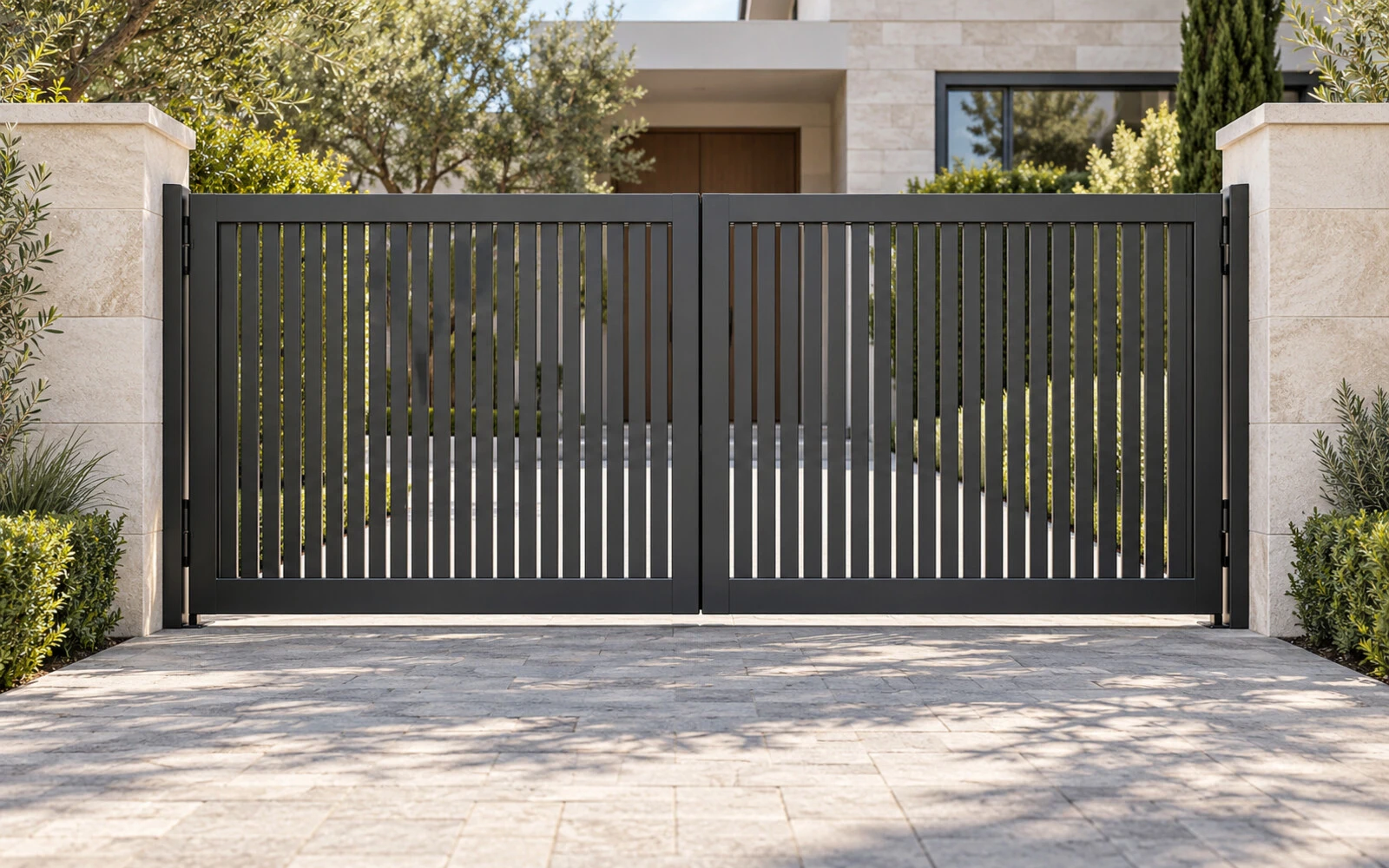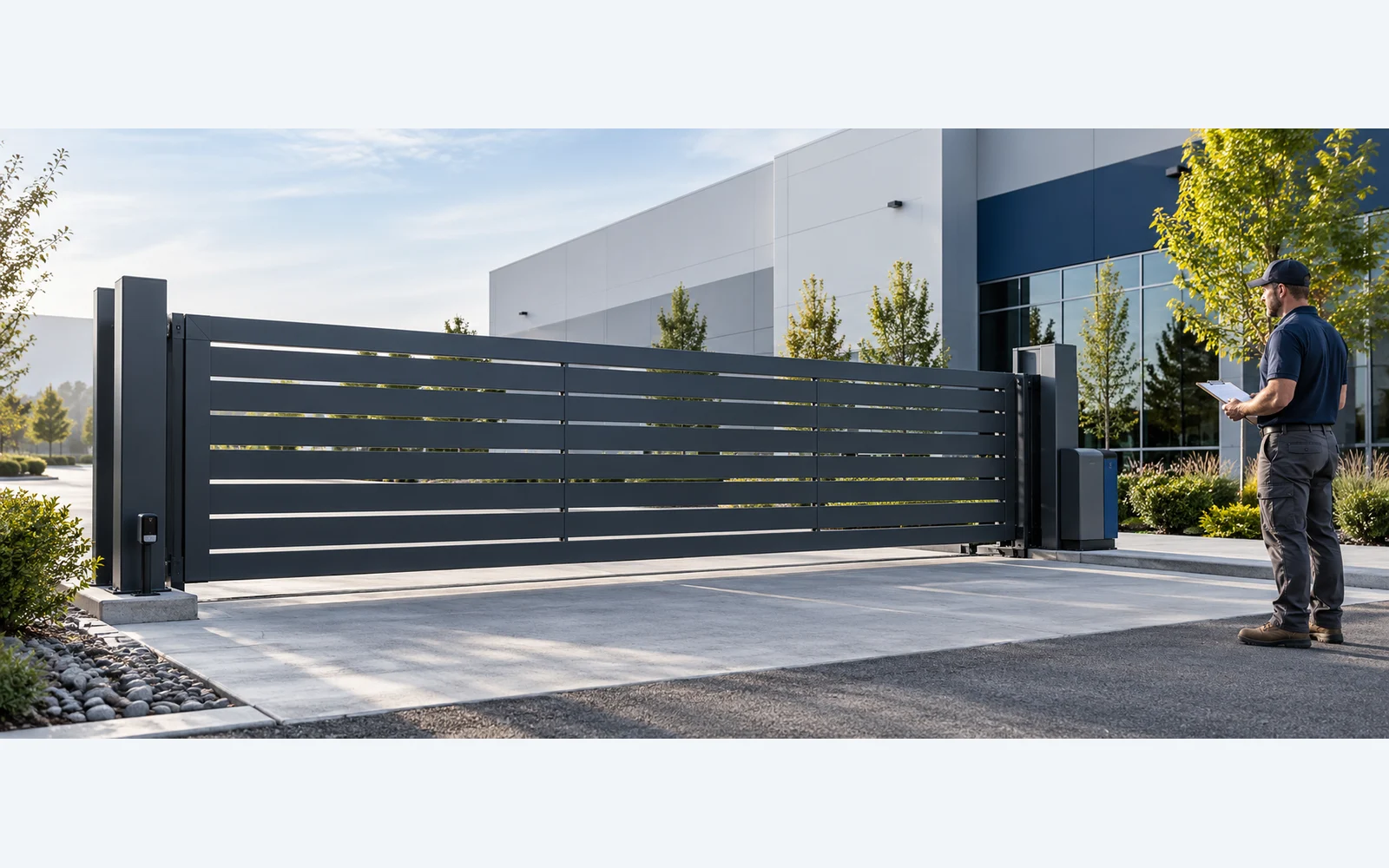
Uphill gate hinges let a swing gate clear a driveway that rises into its opening path. A common design changes the pivot geometry so the free end rises as the leaf swings. The extra clearance can make an inward-opening gate practical where a conventional leaf would scrape the paving. Whether it works depends on where the ground rises and how much clearance the leaf gains at that point.
How uphill gate hinges lift the free end
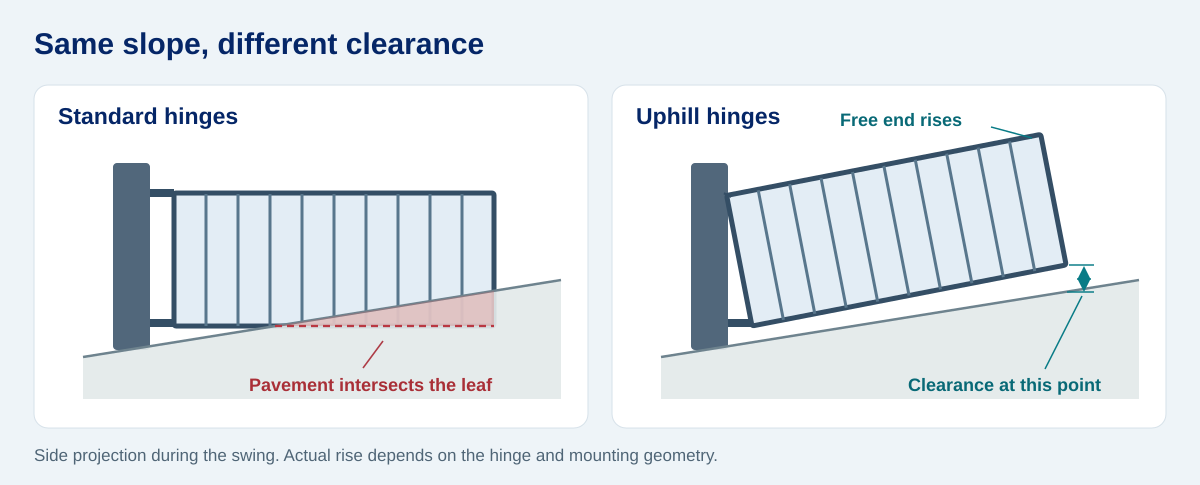
With ordinary swing hinges, the pivot axis is usually vertical, so the gate bottom stays at roughly the same elevation as the leaf turns. An uphill hinge set can offset the upper and lower pivot points or use adjustable joints to make the leaf tilt as it opens. The gate still swings sideways from its post; the rise comes from the way the leaf turns, not from a separate lifting motor.
The exact movement varies by hardware. Some uphill sets use different upper and lower strap lengths; other systems use articulated joints and selectable bracket positions. The installer sets the closed alignment and the opening rise together. A kit that gives the right rise for one leaf can behave differently on another leaf with different hinge spacing, width or mounting geometry.
For residential swing gates, check the leaf and hinge arrangement before finalizing the posts, bottom gap or latch position. The closed leaves still need to line up, even when each leaf follows a different ground profile as it opens.
Check the whole swing path, not just the slope
Start at the gate line. An uphill drive only affects a swing gate if the pavement rises into the area the leaf passes over. A driveway can rise toward the house, fall away from the gate or slope across its width. A raised drain edge, curb or change in paving can also create a local high point that the average grade misses.
If the paving mainly slopes across the closed opening, check the bottom gap from one post to the other before specifying rising hinges. Those hinges change clearance while the leaf moves. An uneven gap with the gate closed is a separate issue and may call for a shaped bottom rail or a change to the threshold.
Use a common level reference and record the finished ground height under the leaf at closed, partly open and fully open positions. Check both the latch end and points closer to the hinge; a hump can catch the middle of the bottom rail. Mark where the leaf is supposed to stop, along with walls and parked vehicles. On a double gate, measure the two sweeps separately.
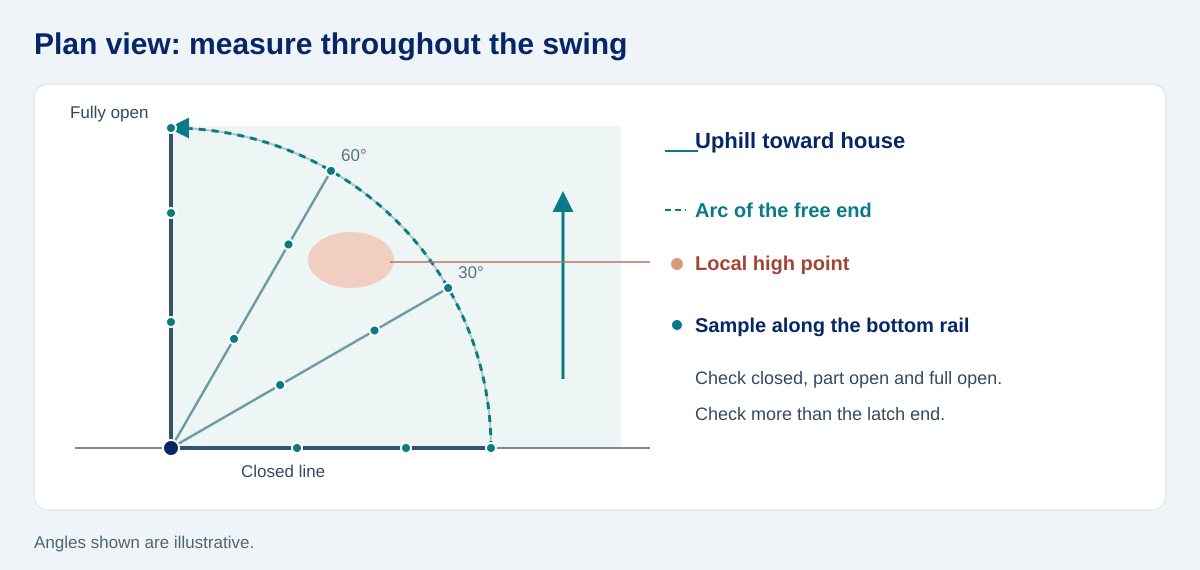
Example: Suppose a point on the bottom rail starts 60 mm above the chosen datum. Partway through opening, it has gained 35 mm of rise, but the pavement directly underneath is 110 mm above the datum. That leaves a nominal clearance of 60 + 35 − 110 = −15 mm: the leaf would touch the ground before reaching that position. A positive clearance at full opening would not solve that conflict. Use the selected hinge supplier’s movement information to check the whole leaf and agree a clearance allowance for the site.
Where rising hinges help, and what they add
A common candidate is a villa entrance where the driveway rises just inside the gate and there is little room along the boundary for a sliding leaf. Rising hinges can retain inward opening and avoid raising the whole gate to clear the worst point. That can help preserve a more modest closed bottom gap, which matters when the entrance also needs to contain pets or limit sight lines.
The trade-off is more to check at the hinges, posts and operator. A longer or heavier leaf changes the loads; a solid infill can add wind load. The gate may also tend to move back downhill when released, depending on the geometry. Confirm how the leaf is controlled in manual operation and at the open position, and whether the post and frame can take the specified hinge fixings.
| Option | When it helps | What to check |
|---|---|---|
| Standard swing on a level apron | The pavement can be kept clear through the entire sweep. | Check transitions and drainage; the level area needs enough depth. |
| Swing with rising hinges | Inward opening is needed and measured rise can clear the paving. | Verify the hinge set, bottom gap, gate loads and opener geometry. |
| Shorter double leaves | A shorter sweep avoids a high point farther into the driveway. | Measure both arcs and check the center latch and stops. |
| Sliding layout | Inward swing space is limited and enough side runback is available. | Check the full travel line, ground clearance and support layout. |
If side space is available, a cantilever sliding gate is another way to keep the leaf out of the inward swing area. Its path and the ground below it still need to be checked; sliding across a slope is different from driving a gate uphill along an inclined travel line. Our guide to gates for limited side space compares more options when both swing and slide space are tight.
Match the opener to the rising motion
An actuator attachment on a rising leaf changes height and angle during the cycle. An opener designed around a level swing may bind or load its brackets in a direction they were not designed to take. Ask the opener manufacturer or installer to confirm the hinge and operator pairing, the allowed joint movement, mounting points, travel limits and manual release procedure. Some approved uphill arrangements use a swivel linkage, but its availability depends on the operator.
Have the installer verify the full travel and safety provisions for the assembled system, including the changing gap below the leaf. If a gate drags or an actuator strains, stop using it and have the geometry checked. Increasing the force setting does not remove an obstruction. Our automatic gate opener maintenance checklist explains what to observe and what to leave to a technician.
Frequently asked questions
How steep a driveway can uphill gate hinges handle?
There is no universal slope limit. A hinge data sheet may give the open leaf angle or rise for a particular hinge spacing and leaf length. Those values are not the same as the maximum driveway grade the installed gate can clear. Compare the stated rise, closed gap and site levels through the entire opening arc.
Can rising hinges be fitted to an existing gate?
Sometimes. The frame and post must accept the specified mounting, and the latch, stop and opener must work with the changed movement. Check the existing gate’s condition before changing its hinges. If the issue is new sag on a driveway that used to clear, diagnose the post, fixings or worn hardware first.
Will two shorter leaves clear the slope more easily?
Shorter leaves sweep a smaller area and may avoid a high point farther into the driveway. They also reach different ground points and may get a different amount of rise from the same hinge geometry. Compare the two arcs and the center latch before choosing a double swing gate design.