A gate loop detector senses a vehicle by measuring a change in the electrical inductance of a wire loop beneath the pavement. The detector sends that information to the gate controller. On a typical one-lane exit, one loop can request an opening when a driver approaches, while a second can tell the controller that a vehicle is still near the gate.
What the Loop, Detector and Controller Each Do
The loop wire creates a detection zone. The detector drives an alternating current through the loop. When enough conductive metal from a vehicle enters the field, it changes the loop’s effective inductance, shifting the frequency of the detector’s sensing circuit. The detector compares that shift with its threshold to decide whether a vehicle is present. The wire does not need to be touched or pressed.
When an inductive loop detector tunes to an empty loop, it establishes a reference for that installation. A vehicle changes the signal relative to that reference. A heavy truck can still produce a weaker signal than a passenger car if its metal chassis sits higher above the pavement. That is why vehicle loop detector sensitivity describes how much change the detector needs to see, rather than a minimum vehicle weight.
The detector turns that measurement into a signal. Depending on the detector and its settings, an output can stay active while a vehicle is detected, or it can send a short pulse when the vehicle enters or leaves the zone. Those are different messages: “a vehicle just arrived” and “a vehicle is still here.”
The controller decides how the gate responds. An output assigned to an EXIT or OPEN input can request opening. A presence output assigned to a compatible HOLD or INTERRUPT input can keep an already open gate from closing while that input is active. Input names and behavior vary by controller. An exit loop is one way to request opening; the same entrance might also accept requests from staff and visitor access controls.
Free Exit Loop, Interrupt Loop and Shadow Loop
Two loops may look identical in the pavement and do different jobs. The name usually describes how the gate uses the signal. Compare the detector’s output mode and the gate operator’s input assignment before you infer the gate’s behavior from a drawing.
| Loop role | Usual purpose | What to verify |
|---|---|---|
| Free exit loop | Requests opening for an outbound vehicle from inside the site. | Whether the exit input expects a pulse or also responds to a maintained request. |
| Interrupt or reversing loop | Uses vehicle presence near the gate to inhibit closing. On some controllers it can also stop and reverse a gate that is already closing. | How the operator responds at the fully open limit and during closing. |
| Shadow loop | Monitors a zone under the gate line or within the gate’s travel area on supported layouts. | When the controller listens to the input. Some operators monitor it at the open limit and ignore it during movement. |
A common point of confusion: pulse on exit on a detector means a pulse when the vehicle leaves the detection zone. A free exit loop describes a lane function: let outbound drivers request opening without presenting a credential. In our example, the free exit loop uses pulse on entry so that the gate can start opening as the vehicle approaches. Some operators also accept a maintained exit request. The presence of an EXIT terminal alone doesn’t tell you which mode is in use.
Follow One Vehicle Through an Industrial Exit
Picture a driver leaving a fenced yard through an automatic sliding gate. In this example, the exit loop is upstream on the site side. A separate presence loop monitors a zone at the gate approach. The plan shows the gate fully open, with the sliding leaf parked along the fence and out of the traffic lane.
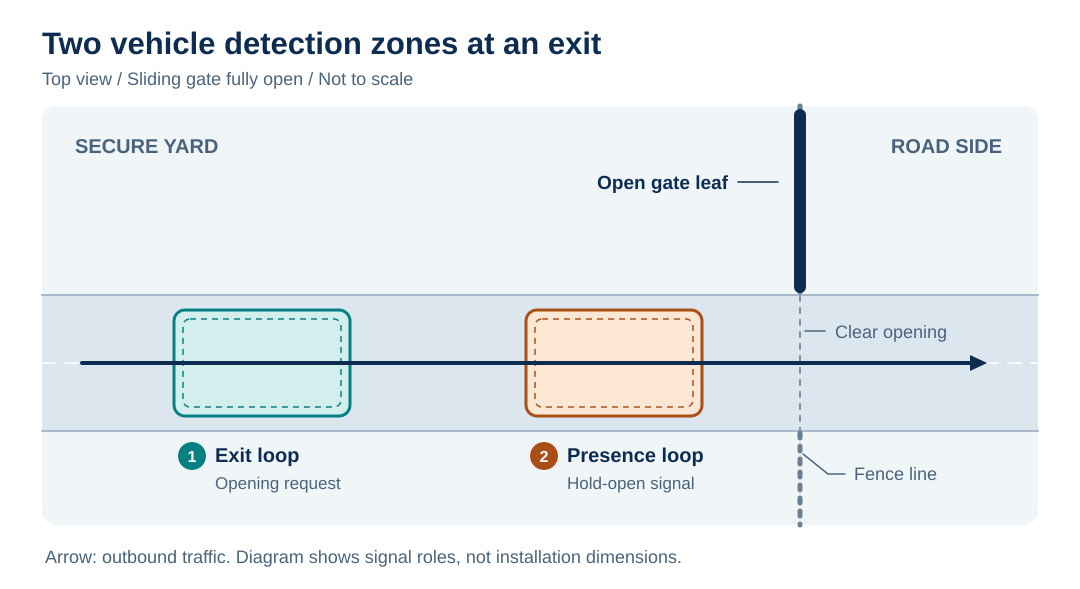
1. The driver reaches the exit loop. The detector sends a brief opening request. The controller starts opening the gate. In this setup, the request ends while the gate is still moving; the pulse has already done its job.
2. The driver rolls onto the presence loop and waits. The presence output is already active when the gate reaches its fully open position. The controller holds the gate open while the loop still detects the vehicle, even though the original opening pulse ended earlier.
3. The driver moves through and the presence zone clears. The detector releases its presence output. In the sequence below, the controller starts its configured close delay once the gate is fully open and the hold input clears. The gate starts closing only after that delay expires and other inputs permit closing. Some controllers resume a paused timer or use another sequence; check the specific operator manual.
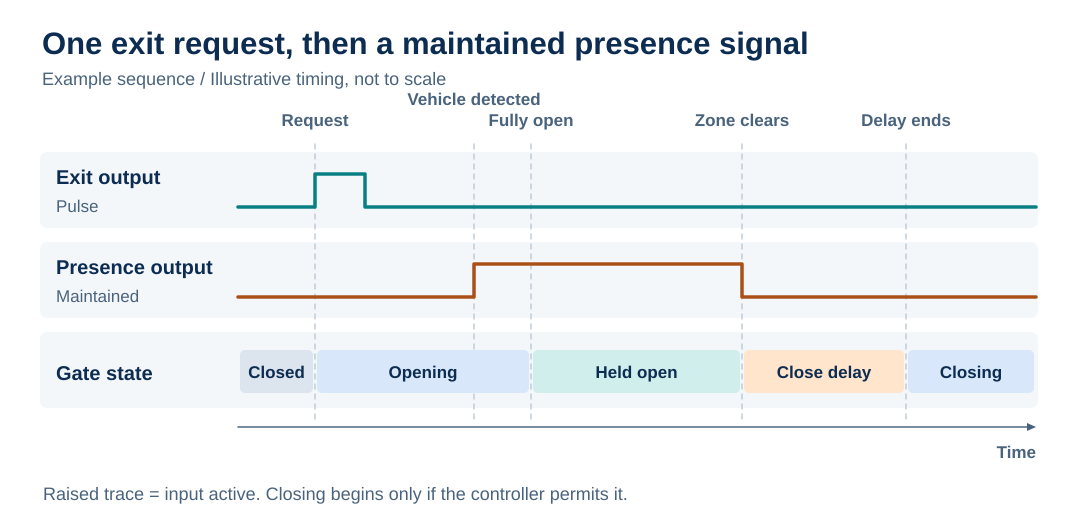
Suppose a second car is already between the two zones when the timer-to-close starts. It then reaches the presence loop without sending a new exit pulse. On an operator configured to pause that timer, the countdown stops while the input is active; an operator configured to reset the timer can start the full delay again when the input clears. If the gate has already started closing, check how that input behaves during motion. An input that holds a fully open gate may behave differently once the gate is moving. Even if the gate stays open for the second car, the loop has not authenticated its driver.
A clear loop reports only that it no longer detects a vehicle in its own zone. It cannot confirm that the entire gateway is clear. If the gate stays open after the vehicle leaves, a maintained detector output, another active input or the controller’s timer can produce similar symptoms. Our guide to an automatic gate that won’t close covers that symptom in more detail.
Why “Safety Loop” Can Be a Misleading Name
In gate discussions, gate safety loop often refers to a vehicle presence loop used to inhibit closing or trigger a configured response when a vehicle is detected. That function covers vehicles in the detection zone. A person on foot will not reliably trigger an inductive loop, and a vehicle can still be in the gateway after leaving one loop’s detection area.
Vehicle detection and entrapment protection are separate functions. Where the gate system calls for monitored photoelectric sensors or sensing edges, keep those devices in the design. On a site with both a parking arm and a sliding gate, verify each device’s inputs and behavior separately: a loop serving one piece of equipment does not automatically protect the other.
What Changes the Detection Zone?
The outline of a driveway loop shows where the wire is laid. Its detection field extends above the pavement, and a detector may respond differently at the edge of that field than at the center. Loop geometry, vehicle underbody height and path through the lane all matter. On a yard that handles articulated trucks, a technician should check whether the presence signal stays active as the gap between the tractor and trailer passes over the loop, and whether the trailer is still in the gateway when the signal clears.
Some detectors offer automatic sensitivity boost (ASB). After the vehicle is first detected, the detector increases its sensitivity so it is less likely to drop the presence signal as a higher part of the vehicle passes. ASB cannot help a vehicle that the detector never picks up in the first place. Raising baseline sensitivity can also make a detector respond to traffic in the next lane. Test the weakest vehicle you expect to detect and the nearest traffic you expect to ignore.
A saw-cut loop is typically fitted into slots cut in existing pavement. A suitable preformed vehicle loop may be installed as part of new paving. Both use the same detection principle. The loop’s twisted lead-in carries the signal back to the detector; it is part of the circuit, even though it is not meant to serve as a second detection zone. At a retrofit, it helps to record where that lead-in runs so a future pavement repair can account for it.
Read the Detector Before Blaming the Gate
Start with three observations: the detector’s presence indicator, its relay or output status if displayed separately, and the corresponding gate operator input. For example, if the detector shows a car and the gate operator never sees an opening request, first check the signal path and output assignment. If both show the request and the gate still does not move, the controller’s state or another input deserves attention. A site technician can make these comparisons without defeating any protective device.
Intermittent detection when the adjacent lane is busy: Find out whether a nearby vehicle is entering the detection field or whether two loop circuits are interfering. Only the second case is loop crosstalk. Changing detector frequency may help electrical interference; it will not move a detection zone that reaches into the wrong lane. If a false call follows the gate’s movement rather than traffic, note where the metal gate leaf is when the detector changes state.
Loop fault with no vehicle present: Some detectors flag an open circuit or a short circuit and can report the fault separately from vehicle presence. Note what the operator sees when a fault occurs. Labels such as fail-safe and fail-secure describe a device’s configured behavior; whether the gate stays open, refuses an exit request or does something else also depends on the controller and its other inputs. Record the fault and output states before anyone resets the equipment. The gate opener maintenance checklist explains what to retain in the service log.
What to Verify During Commissioning
Ask the installer to demonstrate four cases: a slow approach from inside the site, a vehicle waiting in the hold zone, a long vehicle clearing the gate, and a second vehicle arriving during the close delay. For each test, note where the vehicle is when the exit signal changes, when the presence signal releases and when the gate actually moves. At a site with a shared entrance and exit, test both directions; an outbound scenario may not reveal how the gate handles an inbound queue.
Keep the loop layout, detector mode, input assignment and observed close delay together in the handover record. If the gate opens when it should but closes at the wrong point in a vehicle’s passage, that record helps separate a coverage gap from a timer setting or a controller input. Vehicle-loop testing is only one part of commissioning; the gate’s entrapment protection needs its own checks.
FAQ
Will a gate loop detect a vehicle that stops on it?
A detector in presence mode can keep reporting a stationary vehicle if it is within the detection zone and its signal is strong enough. Some detectors have a limited presence time, so confirm that setting if vehicles queue or wait at the gate.
Does every automatic gate need two vehicle loops?
No. The two-loop example separates the exit request from the hold-open signal. A site can use a different device for either function, or use more zones to cover its traffic pattern. Check the controller’s supported inputs and the gate system’s protection requirements before deciding how many zones are needed.
Will a gate loop detect motorcycles?
It can, but the response depends on the motorcycle, where it rides within the zone, the loop geometry and detector sensitivity. If motorcycles use the lane, include them in the site test instead of assuming that a successful car test covers them.
Is a gate loop detector the same as a photo eye?
No. A vehicle loop senses a change in inductance within a zone in the pavement. A typical gate photo eye responds when something blocks its beam. Each device only monitors its own detection area, and its role depends on the gate controller and how the device is used.
Can one loop detector handle two separate loops?
A dual-channel loop detector can monitor two independent loops if the model supports that arrangement. A single-channel detector with two relay outputs is different: both outputs can be derived from the same detection zone. For example, a device might provide both a presence output and an arrival pulse from one loop.
Can an induction loop tell which way a vehicle is traveling?
A basic single loop reports when a vehicle arrives and leaves its zone. Those two events alone do not tell you the direction of travel. For directional detection, a compatible detector or controller can compare the activation order of two separate zones.