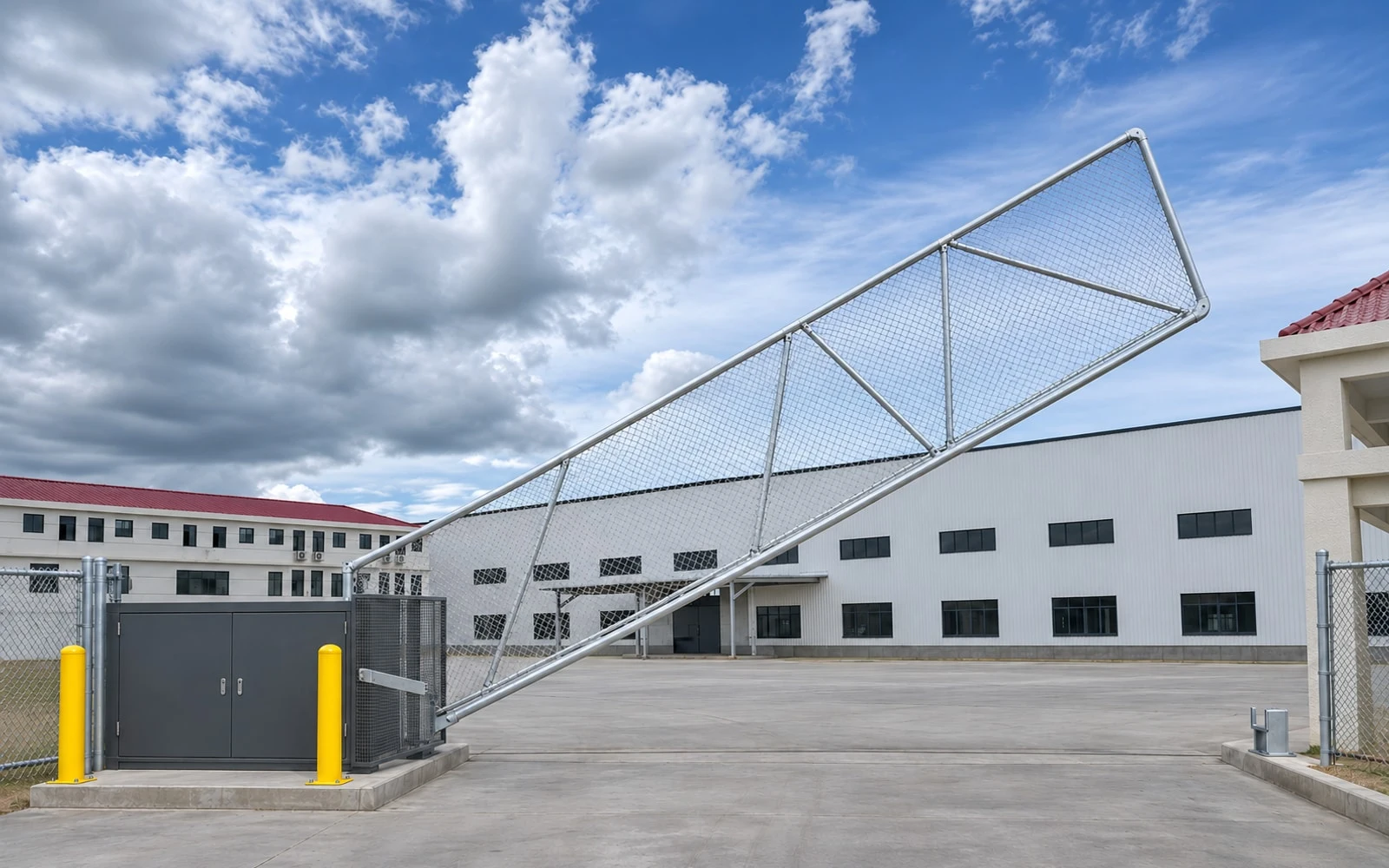
A vertical pivot gate opens by rotating a rigid leaf upward around a pivot at one side of the driveway. A straight vertical lift gate raises the entire panel between guides without changing its orientation. Both free up space beside the opening, but they use the space above it differently.
The names can overlap. Some manufacturers call the rotating design a vertical pivot lift gate. In this comparison, vertical lift gate means a panel that moves straight up and down. If a product listing only says “lift gate,” look at the opening sequence: does one end swing upward first, or do both ends rise together?
How a vertical pivot gate works
When closed, one rigid leaf extends across the opening. The operator turns it around a horizontal axis near one end. Viewed straight on, the long edge of the leaf changes from horizontal to steeply inclined and, on many systems, nearly upright when fully open. The free end follows an arc. The pivot stays in place throughout the cycle.
The operator and its foundation sit beside the opening. Some designs use counterbalance springs to help the operator move the leaf. The pivot support, cabinet and any receiving hardware still need room, even though the leaf does not slide back along the fence. A full-height pivoting leaf closes more of the opening than a parking arm gate, which uses a narrow boom to control a lane.
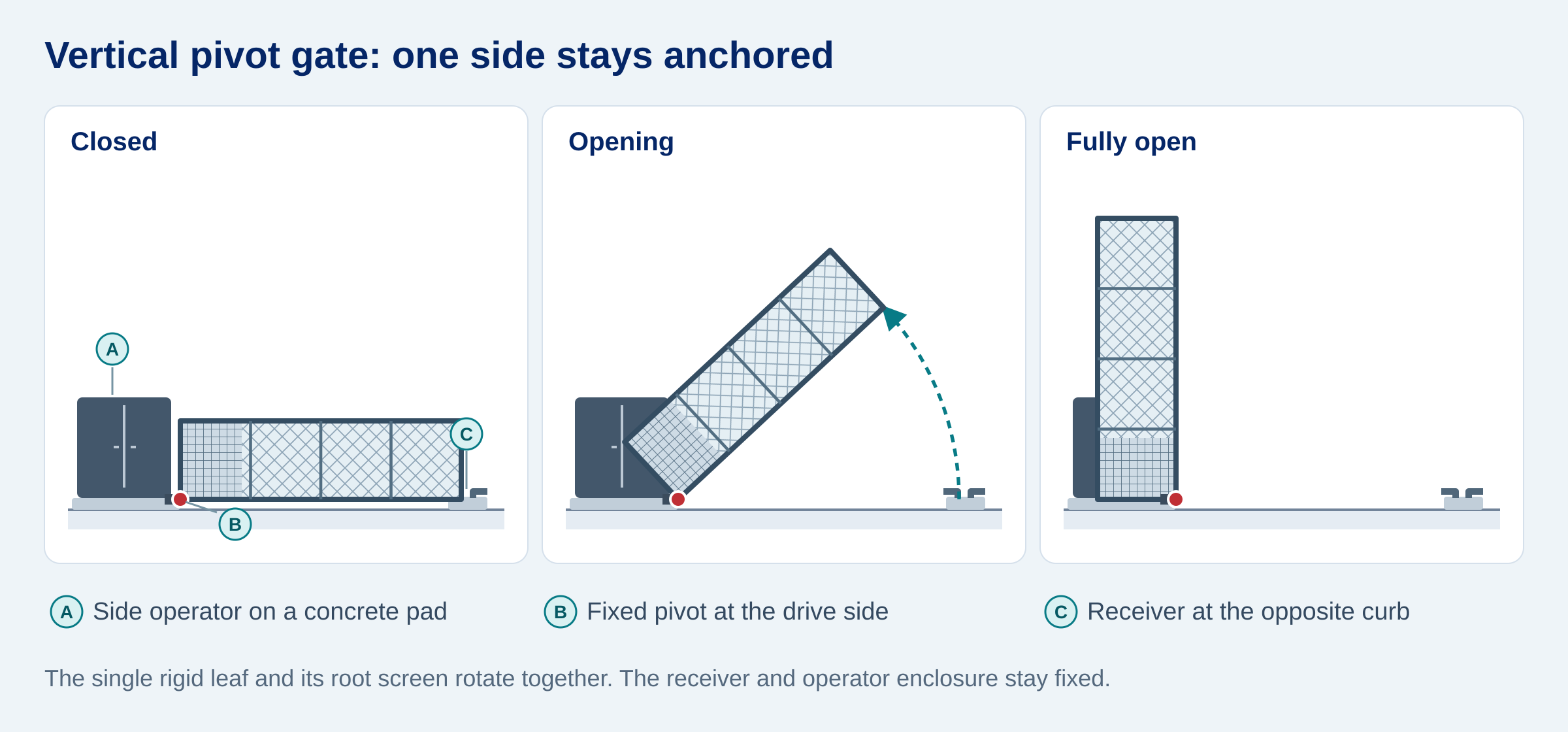
Check the entire swept area, including positions between closed and fully open. A light fitting or branch can miss the upright leaf and still sit in the path of its far corner. A wider leaf generally puts that corner farther from the pivot, so the height of the closed panel alone tells you little about the space needed to open it.
How a straight vertical lift gate works
A straight lift gate moves the panel up between guide structures at both sides of the opening. The two ends rise together; the long rails stay level. In the fully open position the panel is still across the width of the driveway, with its bottom edge above the vehicle passage. The guides hold its alignment during travel.
The drive arrangement depends on the model. Some systems use a chain drive and counterweights inside the support columns. The columns, any overhead crossmember and their foundations are part of the installed system, so reserve space for the whole assembly and for access to service it.
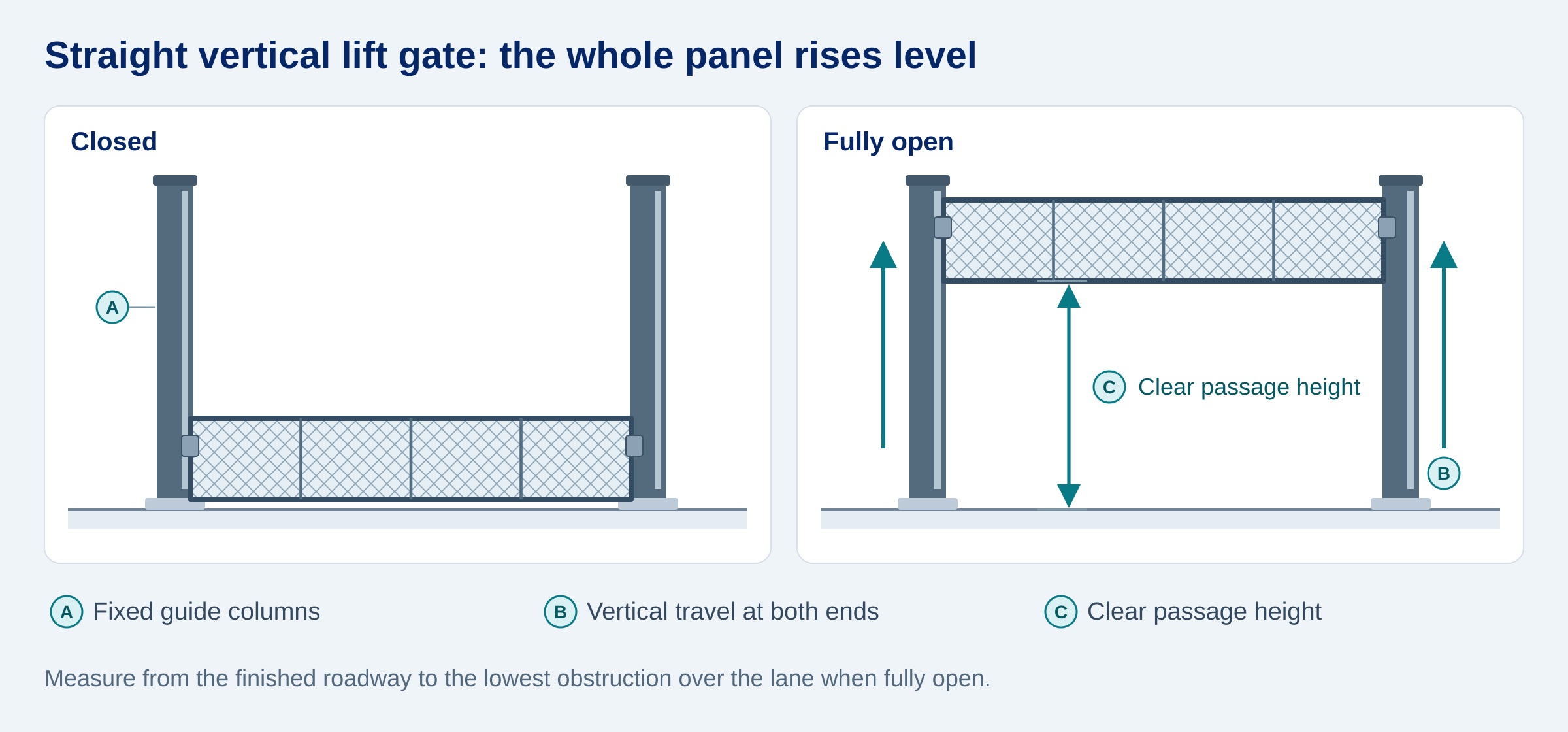
The practical dimension is the clear height under the lowest obstruction when the gate is fully open. That could be the lower edge of the raised panel or a fixed crossmember. Measure from the finished road surface on the vehicle’s route. The height of the guide towers is a separate dimension; it does not tell a driver what can pass beneath the gate.
Where each gate fits: four application examples
Vertical pivot gates: storage yards and airport service lanes
Self-storage entrance beside a short fence return. A keypad island or the corner of a building can leave too little room for a sliding leaf to retract. A pivot gate is worth considering if one side has room for its operator and foundation, and the leaf has a clear path above the lane. Plot the raised leaf and the vehicle turning path together so the cabinet does not end up where a long van needs to turn.
Airport service lane with fencing close to the opening. A mesh pivot leaf can close the gap in the fence while keeping the view across the lane. This layout suits an open-air approach with room for the sweep. On an exposed site, ask the supplier to confirm the operating wind limit for the proposed panel and infill; a solid privacy panel changes the load on the system.
Straight lift gates: truck entrances and confined industrial lanes
Industrial truck entrance with little side runback. A straight lift can serve a wide opening between two fixed guides when there is no place to park the whole leaf beside the lane. Size the opening around the tallest vehicle that actually uses it, including any load or equipment that adds height. The raised panel and any fixed structure must clear that vehicle along its route, including where the road grade changes.
Service lane between a wall and a fence. A lift panel stays in its guide plane, which can help when a parked leaf or a sideways swing would block an adjacent access route. The site still needs a footing and service space at both guides. If a canopy or pipe bridge leaves insufficient room for the raised panel, the small ground footprint offers little benefit.
Pros and cons of vertical pivot and vertical lift gates
| Compare | Vertical pivot gate | Straight vertical lift gate |
|---|---|---|
| Leaf movement | Rotates around a fixed pivot at one side. | Rises straight up, level between guides. |
| Where the leaf sits when open | Near the pivot side, typically steeply raised. | Across the opening, above the vehicle lane. |
| Overhead check | Entire sweep, including the far corner. | Open passage height plus room for panel and supports. |
| Space at ground level | Pivot operator, foundations and receiving hardware. | Two side guide structures, foundations and service access. |
| What to check for service access | Access to the side operator, pivot and counterbalance, if fitted. | Access to both guides and the lifting mechanism, including components above grade. |
Vertical pivot: A fully raised leaf can sit beside the lane without a panel hanging across the opening. The trade-off is the arc: as the leaf gets wider, the far corner generally needs more room to swing. Check the gate and operator as a matched system, including leaf weight, infill and the foundation at the pivot side.
Straight vertical lift: Both ends travel vertically, so a wider leaf does not create a larger rotating arc. The trade-off is that the open panel stays overhead. The guides and supports need enough height for both the panel and the passage below it. Include access to inspect the guides, lifting components and any counterweights in the site layout.
Opening speed, purchase price and maintenance cost are model- and site-dependent. Compare proposals for the same clear width, vehicle height and expected cycles per day. Ask each supplier to include foundations, guarding and service access in the scope; a gate-only price can leave out work that changes the installed cost.
A short fence line can make either upward-moving design worth considering. If the driveway also sits beneath a low canopy, check the actual movement before ruling out a horizontal option. Our guide to gates for limited side space shows how telescopic, sectional and folding designs use the available footprint.
What to measure at the entrance
Start with the clear opening width and the tallest vehicle that will actually use it. Include roof racks, delivery vehicles and service equipment where relevant. Note any change in road level through the opening. A driveway that rises toward the gate may reduce the usable clearance at the point where a vehicle passes beneath it.
On an elevation drawing, mark canopies, overhead services, lighting, trees and the locations available for foundations. Ask for the closed, intermediate and fully open positions on that drawing. For a pivot gate, check the swept outline and the space beside the pivot. For a straight lift, check both the open passage height and the top of the complete structure.
For powered gates, review the movement area, vehicle detection, protective devices and power-loss procedure with the installer. Keep pedestrian access separate from the vehicle gate’s travel path. A lifted panel still needs a safe means of support during servicing; maintenance or manual operation should follow the specific system instructions. See our automatic gate maintenance checklist for what to document at handover.
Frequently asked questions
Is a vertical pivot gate the same as a vertical lift gate?
Some suppliers use “vertical lift” broadly, so the name alone is inconclusive. A pivot gate rotates around one end. A straight lift gate keeps the panel level while both ends move upward in guides. A front elevation showing the opening sequence is the simplest way to tell them apart.
Which type needs more overhead space?
There is no universal answer. Pivot clearance depends on the leaf geometry and the location of the pivot. Straight lift clearance depends on the required vehicle passage height, the panel height and the support structure. Compare dimensioned drawings for the same opening and vehicle requirements.
What if there is a low canopy over the driveway?
Check where the canopy sits relative to the movement plane. If it intersects the sweep of a pivot gate or the raised panel or support structure of a lift gate, compare a horizontal layout. A cantilever sliding gate needs side runback; a bi-folding gate needs room for its panels to fold. Put those movement areas on the same entrance plan before choosing.